
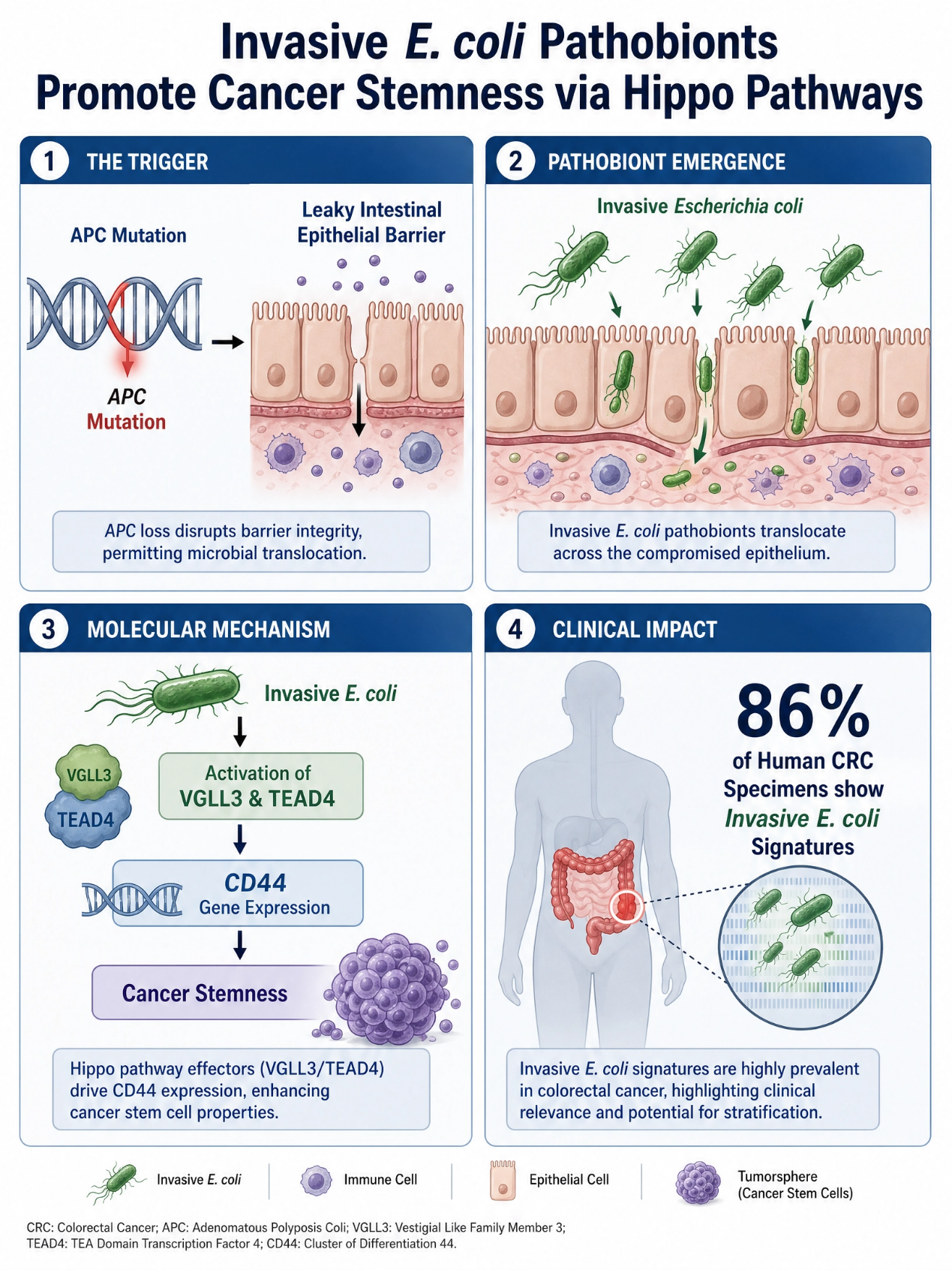

Host genetics-driven expansion of invasive Escherichia coli in the gut microbiome exacerbated tumorigenesis by targeting Hippo pathways to induce cancer stemness via CD44 upregulation. Mouse models of Apc gene mutation and bacteria-epithelial cell cocultures provided proof of concept that invasive bacteria derived from commensal microbes enhanced epithelial clonogenicity. Our data support the use of bacterial precision medicine as an alternative strategy for managing colorectal cancers, even in the hereditary subset.
Longitudinal microbiota analysis showed early-onset epithelial dysbiosis (8 weeks of age) prior to fecal dysbiosis (20 weeks of age), leading to a higher abundance of Escherichia coli in the epithelial cells of gene-mutant Apc(Min/+) mice (top panels). Larger intestinal organoid sizes in gene-mutant mice were observed after exposure to commensal-derived invasive Escherichia coli strain LI60C3, suggesting microbe-induced cancer stemness (bottom panels).
National Taiwan University
Scientists at National Taiwan University College of Medicine have discovered that cancer formation is not simply due to gene mutation. Colorectal cancers primarily originate from epithelial cells that form adenocarcinomas at the interface between host and microbiota. In addition to genetic mutations, the trillions of microbes in the gut environment, termed microbiota or microbiome, play important roles in cancer development. The microbiome is now regarded as a promising therapeutic target, in addition to controlling host factors, for managing colon cancer.
Individuals with hereditary familial adenomatous polyposis caused by mutations in the adenomatous polyposis coli (APC) gene develop numerous benign polyps at a young age throughout both the small and large intestines, with a higher risk of malignant transformation. The abundance of mucosa-associated bacteria in patients with familial adenomatous polyposis implied that microbiota dysbiosis could be a cause rather than a consequence of neoplasms. Recently, the microbiome and dysregulated stemness (self-renewal properties) are two characteristics that have been added to the hallmarks of cancer.
However, why the microbiome becomes dysbiotic and how it fits within the genetic paradigm and influences cancer stemness remain poorly understood. Although the transformation of commensal bacteria into pathobionts (opportunistic pathogens) is a generally accepted concept, longitudinal data tracing the conversion of resident microbes into invasive bacteria are still lacking.
By using mouse models, the research, published in Gut Microbes, indicates that Apc gene mutations trigger microbiota dysbiosis and drive the emergence of invasive Escherichia coli, thereby activating Hippo pathway-mediated cancer stemness. While the invasive E. coli increased tumor clonogenicity in gene-mutant mice, it had no effect on genetically wild type mice.
The results suggest that microbial factors aggravate cancer progression in cases of genetic mutation, but do not induce tumor formation in healthy controls. Invasive E. coli genetic signatures were verified in 86% of human colorectal carcinoma tissues, and a positive correlation with the expression of Hippo effectors was observed. This finding demonstrates that host genetics-driven microbiome alteration plays a crucial role in cancer progression, extending beyond genetic mutations.
“Bacteria-targeting interventions could be an alternative strategy for patients with hereditary tumors,” says corresponding author Yen-Hsuan Ni, distinguished professor of pediatrics and chief in the division of gastroenterology, hepatology, and nutrition in the National Taiwan University Children’s Hospital Department of Pediatrics.
Prof. Yen-Hsuan Ni's email address: [email protected]
Advertisement