
□ The Center for Synapse Diversity and Specificity of the Department of Brain Sciences (Director: Professor Jaewon Ko) at DGIST (President Kunwoo Lee) has made a groundbreaking discovery: when synapses, which connect brain cells, form, the Slitrk protein plays different roles depending on the brain region and surrounding environment, carefully regulating synaptic function. This research helps improve our understanding of how the brain works and is expected to provide important clues for developing treatments for brain disorders such as schizophrenia and autism.
□ There are about 100 billion brain cells (neurons) in the human brain, interconnected by more than 100 trillion synapses. We can think, remember, and act because these connections are made accurately. However, scientists are still unclear about which molecules form these precise connections.
□ The research team focused on the Slitrk protein, which they have been studying consistently since 2013. The Slitrk protein consists of six similar ‘sibling proteins,’ most of which were previously known to perform similar roles. The team began their research by questioning whether Slitrk 1 and Slitrk 2 actually perform the same functions.
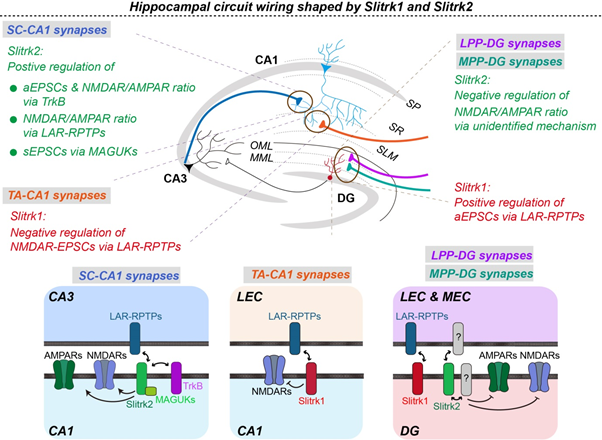
□ Using advanced neuroscience techniques, the research team removed the Slitrk 1 and Slitrk 2 genes in the hippocampus of mice, which are important for memory and learning, and observed changes in synapses. The results confirmed that the two proteins regulate synaptic function in very different ways, depending on their brain locations and the connections they make. In other words, proteins do not always perform the same task but change their roles based on their environment.
□ This study is especially important as it provides solid evidence explaining why difficult brain diseases develop. The research team confirmed that the Slitrk2 gene abnormality found in schizophrenia patients also caused functional issues in specific synapses during animal experiments. This clearly shows how genetic changes related to synapses in patients with various brain disorders, such as autism, schizophrenia, and obsessive-compulsive disorder, result in brain dysfunction.
□ Professor Jaewon Ko explained, "Just as siblings born from the same parents have their own roles and different personalities, this study uncovers a new principle that proteins in the brain manifest different specialties depending on their environment, precisely orchestrating neural circuits. This discovery will serve as a starting point for understanding the causes of brain diseases that exhibit problems only in specific neural circuits and for developing precision treatment strategies that target only the affected synapses."
□ Dr. Dongwook Kim, Dr. Jinhu Kim, and Researcher Byeongchan Kim from the Center for Synapse Diversity and Specificity at the Department of Brain Sciences, DGIST, served as lead authors in this study. Professor Jiwon Um of DGIST's Department of Brain Sciences, Dr. Gyeju Lee of the Korea Brain Research Institute, Professor Changho Sohn of KAIST's Graduate School of Medical Science and Engineering, and Professor Joris de Wit of the University of Leuven in Belgium also participated in this joint research. The findings were published online in the international journal ‘PLoS Biology’ on December 18, 2025. Additionally, this research was funded by the Ministry of Science and ICT and the National Research Foundation of Korea through the Global Leader Research Project, Basic Research Laboratory Support Project, Mid-career Researcher Support Project, and Sejong Science Fellowship.