

Researchers identify a RNA molecule that promotes DNA repair and immune escape to contribute to the resistance of triple negative breast cancer to chemotherapy and targeted therapy.
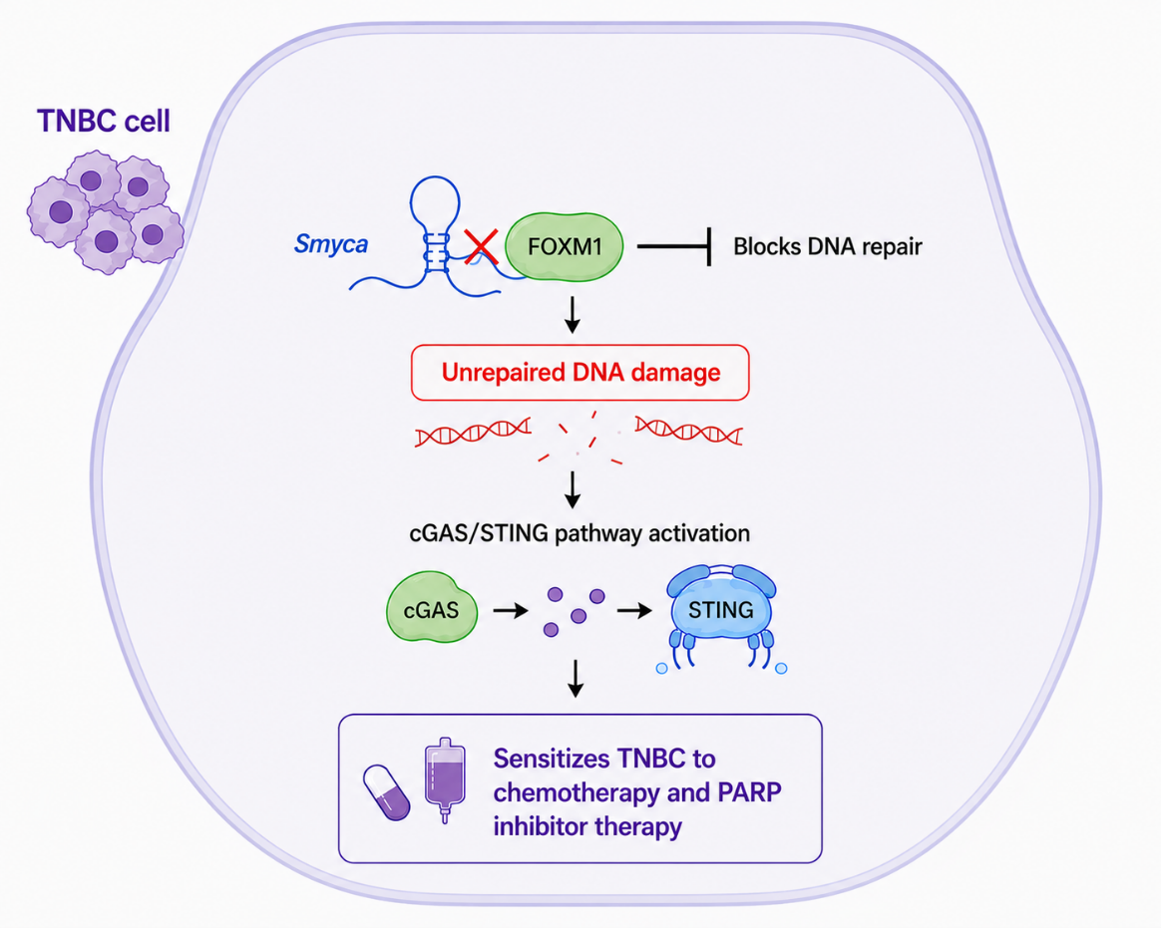
Smyca targeting blocks DNA repair and activates cGAS/STING pathway to sensitize TNBC to chemotherapy and PARP inhibitor therapy.
National Taiwan University
Triple-negative breast cancer (TNBC) is the most aggressive type of breast cancer. Chemotherapy before or after surgery remain as the standard treatment regimen for stage I-III TNBC. Only a small portion of patients can be benefited by targeted therapy with PARP inhibitor, due to the existence of BRCA mutations. However, resistance to chemotherapy or targeted therapy remains as a major hurdle.
In a new study published in Journal of Biomedical Science, researchers at National Taiwan University, Academia Sinica, and Taipei Medical University report a little-known RNA molecule as a culprit to render TNBC resistant to therapy. This RNA is called Smyca, a long non-coding RNA (lncRNA) expressed at high levels in TNBC. Unlike conventional RNAs that provide instructions for making proteins, lncRNAs often fine-tune gene expression to regulate cellular processes.
The researchers discovered that Smyca becomes even more abundant when TNBC receives DNA damage-inducing therapies. Moreover, Smyca promotes the repair of damaged DNA by working closely with FOXM1, an oncogenic transcription factor. In particular, Smyca directs FOXM1 to activate the transcription of a set of DNA repair and nucleotide metabolism genes, which supply repair machinery and DNA building blocks to allow tumor cells recovery from treatment-induced DNA damage.
Thus, Smyca controls a tumor-intrinsic defense program to facilitate the escape from chemotherapy and targeted therapy—a discovery that could point toward new ways to make resistant tumors more responsive to existing treatment regimens.
To prove this concept, the researchers blocked Smyca functions using anti-sense RNA and nanoparticle-assisted delivery of antisense RNA to tumors. This strategy greatly inhibits DNA repair and sensitizes TNBC to chemotherapy and targeted therapy. Furthermore, Smyca targeting activates a potent immune defense effect against tumors. When Smyca targeting is combined with chemotherapy or targeted therapy, the accumulated DNA damage activates cGAS–STING pathway, an immune-sensing system that alerts the body to abnormal cells.
Consequently, tumor immunogenicity is elevated and infiltration of immune cells into tumors is enhanced, thereby promoting the eradication of tumor cells. These responses also convert immune-cold into immune-hot tumor microenvironment, which is known to sensitize tumors to immunotherapy, a standard regimen for treating stage IV TNBC.
“What makes this finding particularly important is that Smyca appears to connect two major mechanisms that allow tumors to survive from therapy, that is, DNA repair and immune escape,” says co-corresponding author Prof. Ruey-Hwa Chen from Institute of Biological Chemistry, Academia Sinica and Institute of Biochemical Sciences, National Taiwan University.
“By targeting this lncRNA pathway, we may be able to weaken the ability of tumors to repair treatment-induced DNA damage and simultaneously make them more exposed to the immune system.”
Prof. Ruey-Hwa Chen’s email address: [email protected]
Advertisement