
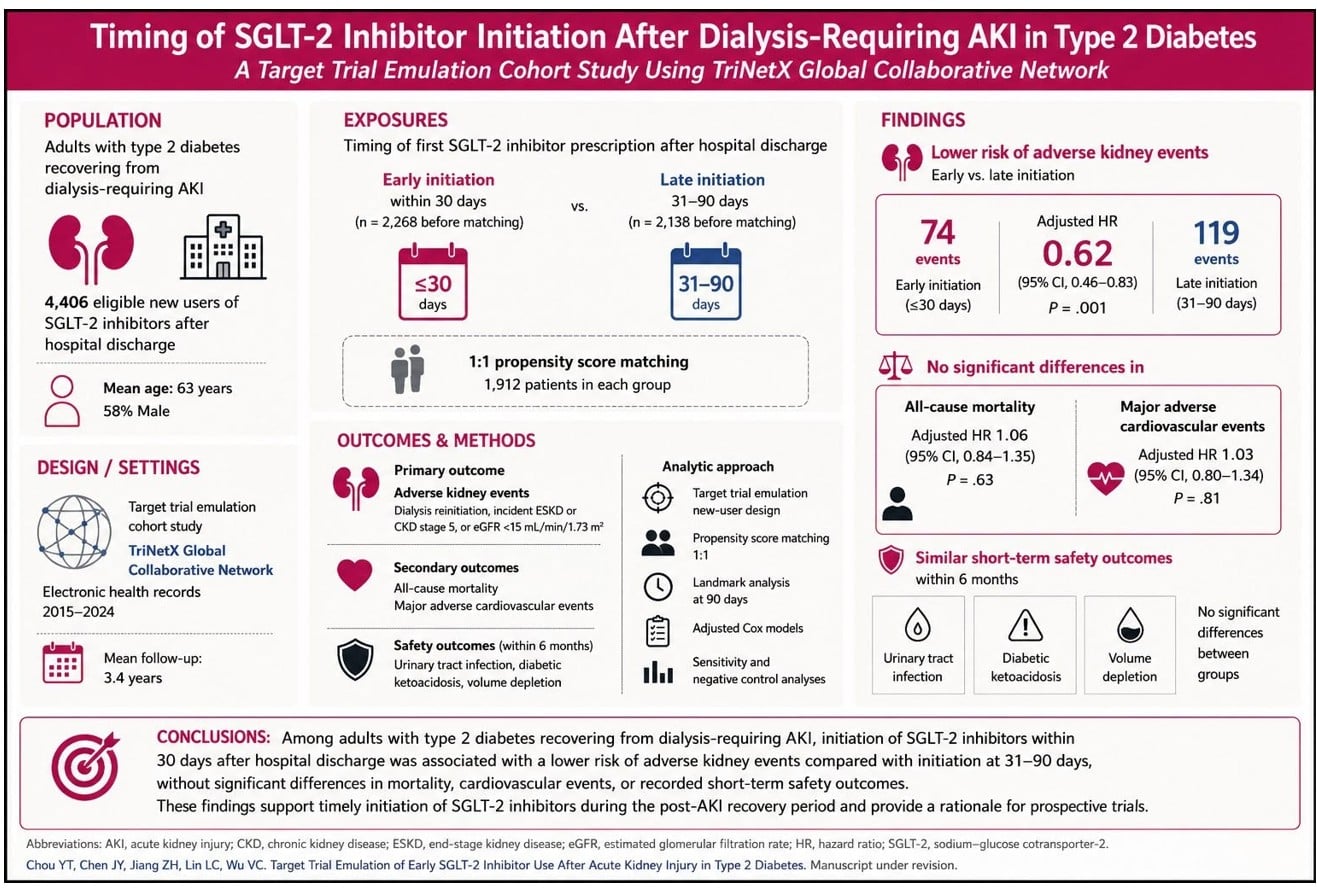
After propensity-score matching, adverse kidney events were recorded in 3.9% of patients who started SGLT-2 inhibitors within 30 days after discharge, compared with 6.2% of those who started 31-90 days after discharge.
Taipei, Taiwan - A study of adults with type 2 diabetes recovering from dialysis-requiring acute kidney injury found that patients who began an SGLT-2 inhibitor within 30 days of leaving hospital had fewer serious kidney events than those who started the medicine 31 to 90 days after discharge. The research, led by National Taiwan University Hospital and published in JAMA Network Open, examines an important question about treatment during kidney recovery.
SGLT-2 inhibitors were first introduced to control blood sugar and are now widely used for kidney and heart protection after several landmark trials. However, people recovering from severe acute kidney injuries have been underrepresented in major trials. Clinicians may therefore hesitate to prescribe these medicines after discharge, when kidney function, blood pressure, and fluid balance may still be fluctuating.
Using deidentified electronic health records from the TriNetX Global Collaborative Network, the researchers identified 4,406 adults with type 2 diabetes who had required dialysis during a hospital stay for acute kidney injury, had stopped dialysis after discharge, and then received their first SGLT-2 inhibitor prescription within 90 days. A statistical matching method was used to make the groups more comparable, leaving 1,912 patients who started within 30 days and 1,912 who started between 31 and 90 days for the main analysis.
Dr. Yu-Ting Chou, first author says, ”Adeverse kidney events were recorded in 74 patients (3.9%) in the early-start group and 119 patients (6.2%) in the later-start group.” The combined outcome included restarting dialysis, progression to end-stage or very advanced kidney disease, or a recorded kidney filtration rate below 15 mL/min/1.73 m2.
The difference was mainly linked to fewer patients reaching this very low level of kidney function; restarting dialysis itself did not differ significantly. Recorded six-month safety outcomes, including urinary tract infection, diabetic ketoacidosis, heart failure, low blood sugar, volume depletion, diabetic retinopathy, and fungal infections of the urinary or genital tract, were similar between groups.
“Although the observational design means that the study cannot prove a direct cause-and-effect relationship, the findings point to treatment timing as a potentially important and modifiable factor in kidney recovery. Timely SGLT-2 inhibitors initiation after severe acute kidney injury may help support kidney recovery without compromising short-term safety," says corresponding author Vin-Cent Wu, M.D., professor of internal medicine in the Division of Nephrology at National Taiwan University and chairman of Taiwan Primary Aldosteronism Investigation.
"The results open a new avenue for the management of acute kidney disease and set the stage for future clinical trials to identify the optimal timing for initiating kidney-protective medications.”
Prof. Vin-Cent Wu's email address: [email protected]