

Materials
News

05 Jul 2021
Osaka Prefecture University
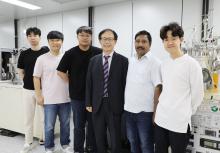
Osaka Prefecture University develops a method to design and control the path of electron flow in a polycrystalline material. Using epitaxial growth approach, researchers address the electrical conductivity problem of thin film materials by realizing a highly conductive in-plane orientation of a metal-organic framework. Furthermore, they show that it is possible to fabricate oriented thin film patterns by integration with UV lithography technology.
05 Jul 2021
Daegu Gyeongbuk Institute of Science and Technology (DGIST)
Scientists used digital circuitry to manipulate and store label-free matters in order to study their unique characteristics

30 Jun 2021
Institute of Industrial Science, The University of Tokyo (UTokyo-IIS)
Researchers from The University of Tokyo Institute of Industrial Science and Fudan University experimentally interrogate a phenomenon that bridges diverse fields of science and engineering
29 Jun 2021
National Institute for Materials Science (NIMS)
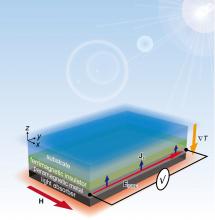
Magnetic layers interact with sunlight differently, creating a temperature gradient that generates electricity day and night.
21 Jun 2021
Daegu Gyeongbuk Institute of Science and Technology (DGIST)
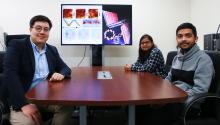
A tiny device incorporates a compound made from starch and baking soda to harvest energy from movement.
18 Jun 2021
Osaka Prefecture University
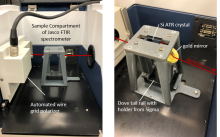
Researchers at Osaka Prefecture University have established an approach to identify the orientation of molecules and chemical bonds in crystalline organic-inorganic hybrid thin films deposited on substrates using Fourier transform infrared spectroscopy (FT-IR) and polarized infrared light with a 3D-printed attenuated total reflectance (ATR) unit. This inexpensive method with laboratory-grade equipment quickly reaches the crystal-structure model of even extremely thin films of less than 10 nm.
16 Jun 2021
Institute of Industrial Science, The University of Tokyo (UTokyo-IIS)
Researchers from The University of Tokyo Institute of Industrial Science report colloidal spheres that can be used to determine the rotational dynamics of dense suspensions
11 Jun 2021
Tohoku University
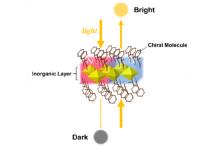
A multi-institutional Japanese team has developed new magnetic design that has magic mirror-like properties. Based on organic-inorganic hybrid perovskite type compounds, the brightness of transmitted light changes depending on whether the material is viewed from the front or the back.

02 Jun 2021
Institute for Integrated Cell-Material Sciences (iCeMS) at Kyoto University
Scientists have found a way to make hydrogen move faster through a solid material at cooler temperatures, paving the way for more sustainable and practical energy storage devices.

02 Jun 2021
Tohoku University
A new nanometer-scale proximity labeling system can target histidine residues quicker than conventional methods thanks to the inorganic chemical singlet oxygen. The discovery generates a new chemical tool in protein chemical modification.
01 Jun 2021
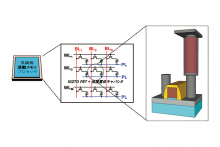
Researchers from the Institute of Industrial Science at The University of Tokyo, Kobe Steel, Ltd, and Kobelco Research Institute, Inc, develop high-density, energy-efficient 3D embedded RAM for artificial intelligence applications.
27 May 2021
Tohoku University
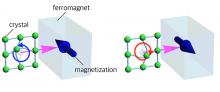
Schematic illustrations of magnetization control by the injection of phonon angular momentum.

25 May 2021
Institute of Industrial Science, The University of Tokyo (UTokyo-IIS)
Researchers at The University of Tokyo Institute of Industrial Science repurpose food waste to build materials with a bending strength comparable to concrete and that still taste good
19 May 2021
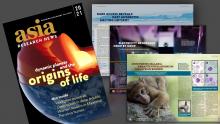
Asia Research News
The Asia Research News magazine brings you fascinating research stories from diverse voices in environment, technology, materials, medicine, space and social sciences. The 2021 edition is out now.
18 May 2021
Daegu Gyeongbuk Institute of Science and Technology (DGIST)
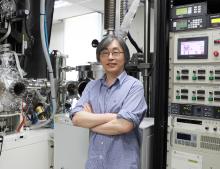
DGIST scientists have found a novel way to control magnetic spins in a localized space.
13 May 2021
Hokkaido University
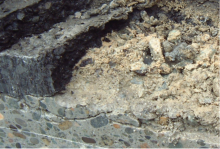
Scientists reveal that the deterioration of modern concrete and asphalt structures is due to the presence of trace quantities of organic matter in these structures.

13 May 2021
Daegu Gyeongbuk Institute of Science and Technology (DGIST)
The trick to extremely thin supercapacitors with improved performance is spraying graphene ink at an angle.

13 May 2021
National Institute for Materials Science (NIMS)
Controlling the organization of molecules within polymer membranes could lead to more efficient fuel cells.
13 May 2021
Tohoku University
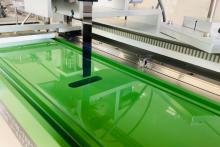
Researchers from Tohoku University have unveiled an ion-selective smart porous membrane that can respond to outer stimuli. Until now, scientists had struggled to apply smart porous membranes to porous thin films of below 10 nm. The developed membranes, however, are applicable to porous thin films with a thickness of 8 nm, paving the way for new applications in molecular separation and sensing applications.

13 May 2021
Lingnan University
Everyone has to wear a mask to curb the spread of COVID-19. However, this is an additional communication barrier for people with a hearing impairment as they cannot read lips or facial expressions behind a mask. Invited by The Hong Kong Society for the Deaf, the Lingnan Entrepreneurship Initiative of Lingnan University in Hong Kong (LU) recently designed a transparent ASTM Level 3 face mask based on the needs of hearing-impaired people, and its fully transparent and anti-reflective design makes lip-reading easier.
13 May 2021
Institute of Industrial Science, The University of Tokyo (UTokyo-IIS)
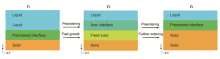
Researchers from the Institute of Industrial Science, The University of Tokyo have shown how glasses that apparently look frozen can crystallize, which could contribute to the improvement of the stability of glassy materials
12 May 2021
National Institute for Materials Science (NIMS)
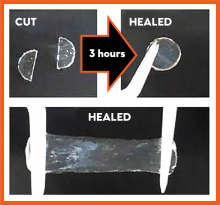
Ion-conducting gels that repair themselves following damage are under development for wearable electronics.

12 May 2021
National Institute for Materials Science (NIMS)
Heusler alloys are promising contenders for faster and more energy-efficient computing and memory storage devices.

12 May 2021
National Institute for Materials Science (NIMS)
Molecular interactions within gels and rubbers can be controlled to fabricate stronger and more elastic materials.

12 May 2021
National Institute for Materials Science (NIMS)
An artificial intelligence approach extracts how an aluminium alloy’s contents and manufacturing are related to specific mechanical properties.

12 May 2021
National Institute for Materials Science (NIMS)
From biomemory to implants, researchers are looking for ways to make more eco-friendly electronic components.

10 May 2021
National Institute for Materials Science (NIMS)
Complex algorithms can be taught to predict steel corrosion rates in coastal regions, helping engineers choose the best materials for each location.

27 Apr 2021
Tohoku University
Cells breathe, to an extent, exchanging gases, taking in energy sources from the environment and processing it. Now, researchers from Tohoku University have shone a light on the process in a new way.
27 Apr 2021
Ehime University
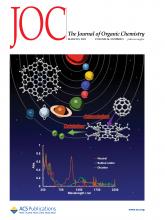
A facile synthesis of two types of pyrrole-fused azacoronene with planar and double-concave π-structures was achieved.
The two electron-rich azacoronenes were found to interact with electron-deficient π-electron compounds depending on their three-dimensional structures.
Azacoronene with a curved structure was found to be less aromatic than those with a planar one based on macrocyclic π-conjugation.
20 Apr 2021
Hiroshima University
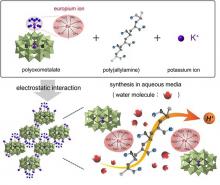
Protons are the next big thing when it comes to fuel cell technology. The subatomic exchange produces power on a scale that challenges contemporary solid-state fuel cell technology, used to help power space shuttles. To realize the proton-based technology sooner, an international team of researchers have developed a hybrid material that effectively transports protons at high temperatures and humidity — two major challenges in past attempts.
Events
Sorry, no events coming up for this topic.
Researchers
Sorry, no researchers coming up for this topic.
- « first
- ‹ previous
- 1
- 2
- 3
- 4
Giants in history

Abdus Suttar Khan (c. 1941 – 31 January 2008) was a Bangladeshi engineer who spent a significant part of his career conducting aerospace research with NASA, United Technology and Alstom.

Lin Lanying (7 February 1918 – 4 March 2003) was a Chinese material engineer remembered for her contributions to the field of semiconductor and aerospace materials. Lanying was born into a family who did not believe in educating girls and she was not allowed to go to school.