

Technology
News

04 Jul 2016
Singapore Management University
To maximise their bottom line, online retailers must integrate digital business data with physical product flow, according to researchers from Singapore Management University.
04 Jul 2016
Singapore Management University
Fears that recreational drones could be used for spying or terrorism are based on little more than paranoia according to research from Singapore Management University.

29 Jun 2016
King Abdullah University of Science and Technology (KAUST)
Graphene quantum dots can improve the efficiency of silicon solar cells.

29 Jun 2016
The Agency for Science, Technology and Research (A*STAR)
Computer model fills fundamental knowledge gaps of a high performance solar material.
29 Jun 2016
The Agency for Science, Technology and Research (A*STAR)
A combination of advanced signal processing and magnetic layer stacking promises to increase hard drive capacity and reliability.
29 Jun 2016
The Agency for Science, Technology and Research (A*STAR)
Tired of running out of charge on your smartphone? The hunt is on for a longer-lasting battery.
27 Jun 2016
National Institute for Materials Science (NIMS)
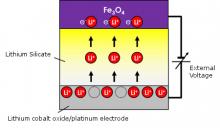
Use of Ion Conducting Solid Electrolyte Created a Breakthrough. A Step toward Realization of Low-Current High-Capacity Memory Devices.
27 Jun 2016
National Institute for Materials Science (NIMS)
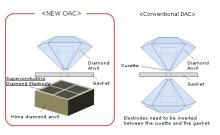
Integration of a Hime Diamond into the Device Simplifies Measurement of Electrical Resistance under Ultra-High Pressure.

27 Jun 2016
Tohoku University
Researchers have developed a way to protect data and enable information services to continue working in disaster-affected areas, even when there is a network disruption over a wide area preventing access to remotely located back-ups.

24 Jun 2016
Korea Advanced Institute of Science and Technology (KAIST)
A group of KAIST researchers will share their insights on the future and challenges of the current technological innovations impacting all aspects of society, while showcasing their research excellence in artificial intelligence and robotics.
24 Jun 2016
The Agency for Science, Technology and Research (A*STAR)
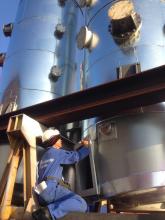
Scientists in Singapore have developed a revolutionary emissions abatement system that removes pollutants from exhaust gas to help the international shipping industry meet ambitious emissions targets.

24 Jun 2016
Asia Research News
Researchers in Malaysia have discovered that dried sewage sludge could be recycled by adding it to cement to make concrete.
23 Jun 2016
King Abdullah University of Science and Technology (KAUST)
Biology has inspired new ways to harvest and collect water.
23 Jun 2016
King Abdullah University of Science and Technology (KAUST)
A statistical model that accurately describes rainfall at both extremes opens the way for more reliable predictions of flood and drought risk.
23 Jun 2016
Hokkaido University
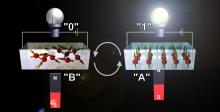
Scientists at Hokkaido University have developed a device that employs both magnetic and electronic signals, which could provide twice the storage capacity of conventional memory devices, such as USB flash drives.

22 Jun 2016
Asia Research News
Computer modelling based on microclimate data from a Malaysian public park has shown how adding trees and grass can improve living conditions in dense city cores.
17 Jun 2016
Hokkaido University
Building an innovation ecosystem to expand to other regions.
17 Jun 2016
Tohoku University
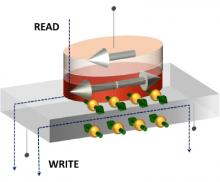
The research group of Professor Hideo Ohno and Associate Professor Shunsuke Fukami of Tohoku University has demonstrated the sub-nanosecond operation of a nonvolatile magnetic memory device.
17 Jun 2016
Tohoku University
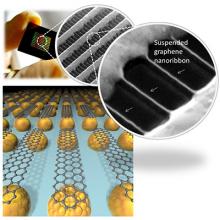
Researchers at Tohoku University have realized wafer-scale and high yield synthesis of suspended graphene nanoribbons. The unique growth dynamic has been elucidated through comparing experiments, molecular dynamics simulations and theoretical calculations made with researchers from the University of Tokyo and Hokkaido University.
17 Jun 2016
Tohoku University
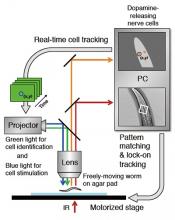
Researchers from Osaka University and Tohoku University have developed a novel robot microscope system that automatically tracks a freely moving small animal and manipulates its brain activity with "projection mapping." They've named the system OSaCaBeN or OSB.
16 Jun 2016
The Hong Kong Polytechnic University (PolyU)
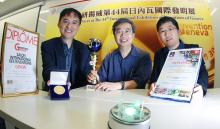
Researchers in Hong Kong have developed a system named "Compound eye for high-density 3D imaging".

16 Jun 2016
The Agency for Science, Technology and Research (A*STAR)
A mathematical analysis of urban traffic models clarifies a dispute over which approach is the best.
16 Jun 2016
The Agency for Science, Technology and Research (A*STAR)
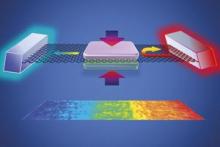
Squeezing graphene is a way to control its heat conduction, paving the way to harvesting waste heat for power.

15 Jun 2016
National Institute for Materials Science (NIMS)
Scientists in Japan have successfully recorded the atomic bonds between diamond and cubic boron nitride: the hardest known materials on earth. This feat could ultimately lead to the design of new types of semiconductors.
14 Jun 2016
King Abdullah University of Science and Technology (KAUST)
A new understanding of why tungsten-doped thin films degrade so rapidly in air may lead to better designs for semiconductor technologies.
14 Jun 2016
King Abdullah University of Science and Technology (KAUST)
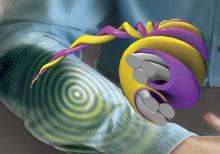
Smart threads can be woven into pressure-sensitive electronic skin for robots or medical prosthetics.
14 Jun 2016
King Abdullah University of Science and Technology (KAUST)
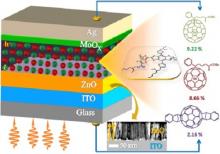
Understanding the dynamics of electrons in polymers will enable more efficient solar cells.
13 Jun 2016
National Institute for Materials Science (NIMS)
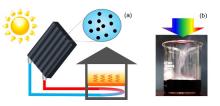
—Success May Promote Solar Heat Utilization Based on Plasmon Resonance of Ceramic Materials—
13 Jun 2016
National Institute for Materials Science (NIMS)
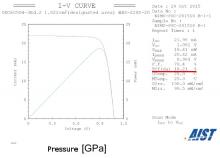
A research group in Japan achieved energy conversion efficiency exceeding 18% using standard size perovskite solar cells for the first time in the world.
13 Jun 2016
National Institute for Materials Science (NIMS)
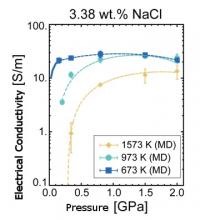
—A Step Forward in Understanding Mechanisms behind Magma Generation and the Outbreak of Earthquakes—
Giants in history

Turkish astrophysicist Dilhan Eryurt (29 November 1926 – 13 September 2012) conducted research on how the sun affects environmental conditions on the moon.
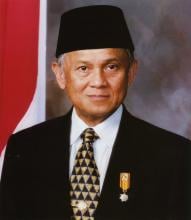
Bacharuddin Jusuf Habibie (25 June 1936 – 11 September 2019) was an Indonesian engineer who was President of Indonesia from 1998 to 1999.

Physicist Narinder Singh Kapany (31 October 1926 – 4 December 2020) pioneered the use of optical fibres to transmit images, and founded several optical technology companies. Born in Punjab, India, he worked at a local optical instruments factory before moving to London for PhD studies at Imperial College. There, he devised a flexible fibrescope to convey images along bundles of glass fibres.

Sir Mokshagundam Srinivasa Shastry Vishveshwarayya (15 September 1860 – 14 April 1962) is widely regarded as India’s most outstanding engineer. In a career that spanned almost his entire life, Vishveshwarayya played a pivotal role in several engineering projects, including designing the Krishnarajasagara dam that is still the source of irrigation and drinking water for parts of Karnataka today.
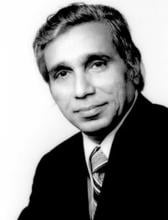
Fazlur Rahman Khan (3 April 1929 – 27 March 1982) was a Bangladeshi-American structural engineer and architect who invented the tube principle, which formed the basis for modern skyscraper design.
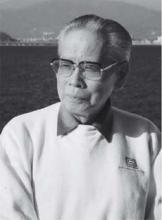
A Japanese surgeon, Tetsuzo Akutsu (20 August 1922 – 9 August 2007) built the first artificial heart capable of keeping an animal alive.

Lin Lanying (7 February 1918 – 4 March 2003) was a Chinese material engineer remembered for her contributions to the field of semiconductor and aerospace materials. Lanying was born into a family who did not believe in educating girls and she was not allowed to go to school.

Gregorio Y. Zara (8 March 1902 – 15 October 1978) was a Filipino engineer and physicist best remembered for inventing the first two-way video telephone. Zara’s video telephone invention enabled the caller and recipient to see each other while conversing, laying the foundation for video-conferencing