

Graphical Abstract
Parkinson's disease (PD) is a common neurodegenerative disorder that profoundly affects motor function, significantly reducing the quality of life. While accumulating evidence has suggested clear sex differences in the epidemiological and clinical features of PD, the sex-specific aspects of motor unit behavior have not been fully explored.
A groundbreaking study by an international research team, with Dr. Yuichi Nishikawa from the Faculty of Frontier Engineering at Kanazawa University as the lead author, has now revealed sex differences in motor unit firing patterns in patients with PD. This research meticulously analyzed the asymmetry of motor unit activity, specifically discharge rates and persistent inward currents (PICs), using high-density surface electromyography (HD-SEMG).
The study involved 27 participants (14 females and 13 males) who performed a contraction task at 30% of their maximal voluntary contraction (MVC). Motor unit spike trains were decomposed from HD-SEMG data, and both mean discharge rates and PICs were estimated.
Key findings include:
- Female patients presented significantly greater laterality of discharge rate (p=0.001) compared to males.
- Females also exhibited significantly lower PICs (p=0.0121) than males. PICs are crucial for neuronal excitability, and this reduction suggests that the impact of neurodegeneration might be more pronounced in females.
- A significant correlation between the discharge rate and recruitment threshold was observed on both sides in males and on the less-affected side of females, but not on the more-affected side of females. This disruption suggests impaired rate coding or recruitment order on the more-affected side in females.
These results unequivocally demonstrate the existence of sex differences in motor unit behavior in patients with PD. Notably, these physiological differences emerged despite comparable clinical symptom severity (UPDRS Part III scores) between male and female participants. This underscores the potential of motor unit-level metrics to unveil subclinical, sex-specific changes in neuromuscular control that may not be apparent from clinical symptoms alone.
The research team suggests that a decrease in estradiol levels due to menopause may contribute to the observed differences in neuromuscular impairment in female patients with PD. Estradiol is known to increase dopamine synthesis, release, reuptake, and metabolism, and it also possesses anti-inflammatory effects. Therefore, the reduction in estradiol concentration in postmenopausal women could be a significant factor accelerating neurodegeneration and disease severity, contributing to abnormal motoneuron activity.
This study's findings mark a crucial step forward in understanding sex differences in the pathophysiology of PD. Moving forward, these insights are expected to contribute to the development of personalized diagnostic methods and treatment strategies that account for sex-specific factors, ultimately leading to more effective interventions and improved quality of life for individuals with PD.
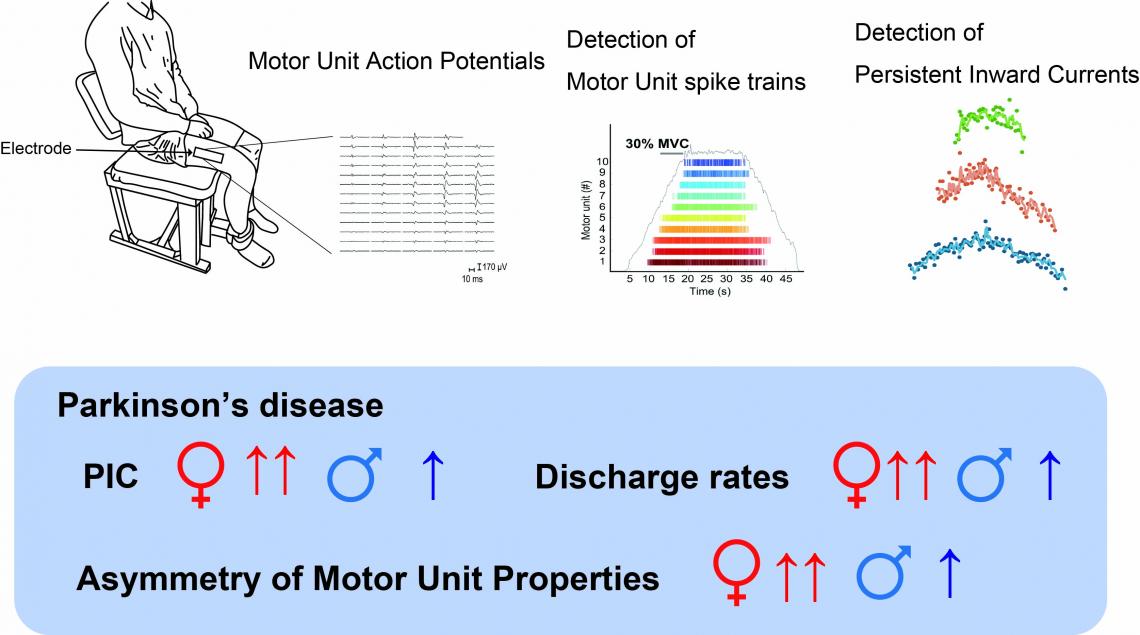
This study utilized high-density surface electromyography and motor unit decomposition to investigate sex differences in motor unit firing behavior in patients with Parkinson’s disease. Females exhibited greater asymmetry in firing properties between more- and less-affected sides, including lower estimates of persistent inward currents (ΔF), higher discharge rates, and increased interspike interval variability. In contrast, males demonstrated more symmetrical and stable motoneuron activity.
About Kanazawa University
— Contributing to Society through “Future Oriented Intelligence”, Built on an “All Kanazawa University” Approach.
Kanazawa University (KU), founded in 1862, is a research university dedicated to education, while opening up its doors to both local and global society. Guided by our vision, “Kokorozashi,” we contribute to society through “Future-oriented Intelligence,” addressing current challenges and anticipating future ones from both local and global perspectives.
KU includes 4 colleges, 20 schools, 7 graduate schools, a hospital, and specialized research centers such as the Cancer Research Institute, a leading hub for research on cancer metastasis and drug development. Over 1,000 researchers drive innovation and international collaboration across diverse fields.
KU is advancing research through WPI (World Premier International Research Center Initiative) and J-PEAKS (Program for Forming Japan’s Peak Research Universities), accelerating interdisciplinary and international collaborations and innovations.
Learn more here: https://www.kanazawa-u.ac.jp/en/