
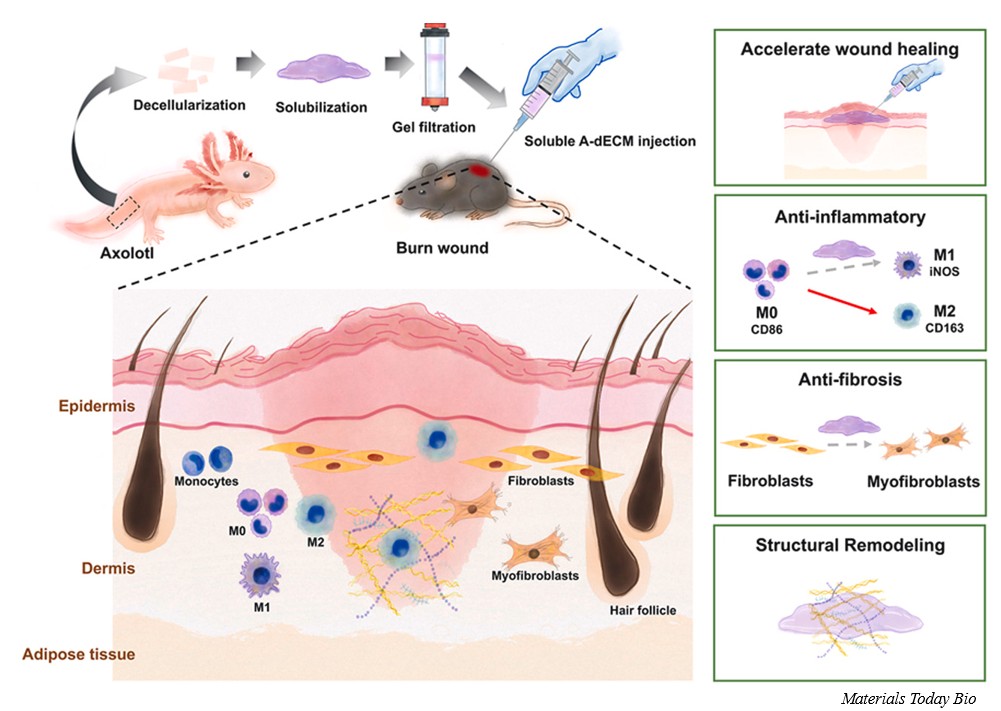
The graphical abstract shows how skin from the highly regenerative axolotl was processed into a cell-free extracellular matrix material and tested in mammalian wound repair. In mouse burn wounds, the axolotl-derived material helped guide the wound environment toward faster closure, reduced inflammatory and fibrosis-related signals, and more organized rebuilding of skin tissue. https://www.sciencedirect.com/science/article/pii/S2590006425010142
Axolotls are famous for doing what humans cannot: repairing major injuries with little or no scarring. A research team in Taiwan has now used this unusual ability as inspiration for a cell-free wound-healing material designed to help guide mammalian wounds toward more regenerative and less fibrotic healing.
The study published in Materials Today Bio focused on the natural support structure of axolotl skin. Rather than transplanting living cells, the researchers removed the cells from axolotl skin and kept the surrounding biological framework. This cell-free material preserves many of the physical and biochemical cues that normally help cells decide where to move, how to grow, and how to rebuild damaged tissue.
Scarring remains a major challenge after burns, surgery, trauma, and chronic wounds. In adult mammals, injury often triggers strong inflammation, activated scar-forming cells, and disorganized collagen buildup. These responses can close the wound, but they do not fully restore normal skin structure. The result is often stiff, fibrotic tissue that looks and functions differently from uninjured skin.
To explore whether axolotl skin carries useful regenerative instructions, the team first prepared axolotl-derived skin material and confirmed that most cellular components had been removed while key structural components were retained. They also refined the material by separating out fractions that appeared less favorable for skin cell growth. After this purification step, the axolotl-derived material supported the growth of human skin cells in laboratory tests.
The researchers then tested the material in a mouse burn wound model. Compared with saline-treated wounds and wounds treated with mouse-derived material, the axolotl-derived material promoted faster wound closure and improved rebuilding of the outer skin layer. By later stages of healing, treated wounds showed better organized collagen and skin architecture, suggesting improved restoration rather than simply faster closure.
The material also changed the wound environment. It reduced inflammatory and fibrosis-related signals, including markers associated with scar-forming cells. It also lowered pro-inflammatory immune activity while supporting signals associated with repair-friendly immune responses. Together, these changes suggest that the material did more than simply fill a wound; it helped guide how the host tissue responded to injury.
The findings are still at an early stage, and the material is not yet a treatment for human wounds. The work was performed in cells and mice, and further studies will be needed to evaluate long-term safety, dosing, manufacturing scalability, and whether similar effects can be achieved in human wounds.
However, the study points to a promising future direction: wound dressings and injectable biomaterials may one day be designed not only to protect injured tissue, but also to steer it away from fibrotic scarring and toward more complete repair.
“By learning from an animal that naturally avoids scarring, we hope to develop new ways to guide human wounds toward more complete repair,” says co-corresponding author Nai-Chen Cheng, M.D., Ph.D., chief and professor of plastic surgery at National Taiwan University.
Prof. Nai-Chen Cheng's email address: [email protected]
Advertisement