
Researchers at the University of Osaka have synergistically combined three strategies for energy dissipation to enhance the toughness of elastomers. Rotaxane molecules with sacrificial bonds are incorporated into an elastomer. Under increasing external force, three mechanisms become sequentially activated: sliding of the rotaxane molecules, force-induced bond scission in the rings to form linear chains, and entanglement of the resulting chains. A polyurethane elastomer synthesized using this strategy was five times tougher than a conventional polyurethane.
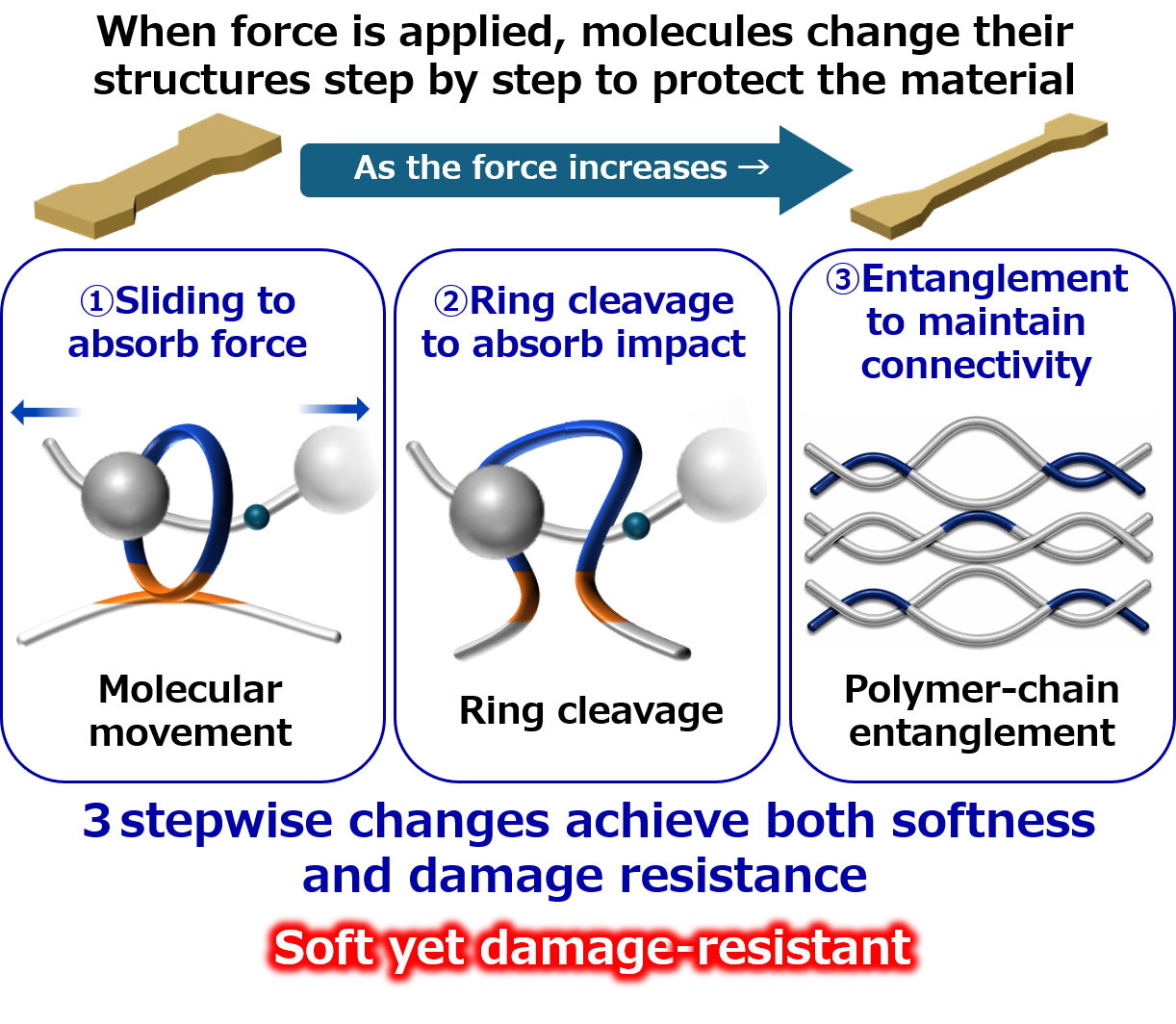
Fig. 1
Under an applied force, sequential molecular transformations suppress material failure
Original content, Credit must be given to The University of Osaka. Adaptations and redistribution are permitted., The University of Osaka
Researchers at the University of Osaka develop a novel strategy for toughening elastomers by dissipating stress
Osaka, Japan – Your shock-absorbing sneaker soles are likely made of polyurethane, a highly elastic and tough polymer. The ability of these elastomers to absorb impact without breaking is extremely important for practical applications, and while multiple strategies exist for enhancing elastomer toughness, each has its limitations. However, achieving synergistic toughening by integrating all three mechanisms within a single material remains challenging.
Now, researchers at the University of Osaka have overcome these limitations by developing a multipath synergistic strategy to toughen elastomers. This exciting discovery will be reported in Nature Communications.
Elastomers are polymers that are exceptionally elastic, i.e., they can deform strongly under external stress and revert to their original shape when the stress is removed. However, traditional elastomers are not very tough, as microscopic cracks can cause the material to tear.
Consequently, strategies are employed to enhance the toughness of elastomers by dissipating energy. That is, during deformation, the polymer absorbs mechanical energy and dissipates it by converting it into other forms of energy.
To reduce the likelihood of tears, three types of energy dissipation strategies can be employed.
i) Molecular sliding – Rotaxane molecules are incorporated into the elastomer, which slide and rotate under an external force, redistributing stress across the network and preventing breakage.
ii) Force-induced bond scission – Molecules are embedded in elastomers with “sacrificial” bonds that break under an applied stress, delaying damage to the elastomer.
iii) Chain entanglement – Molecular design is used to introduce structurally well-defined chain entanglements, which allow chains to slide and rearrange tension across the network when stress occurs.
Individual energy-dissipation strategies provide only a limited improvement in elastomer toughness. Although multiple mechanisms have been incorporated into a single material, achieving synergistic toughening by activating them sequentially as the applied stress increases remains challenging.
“We integrated three energy dissipation pathways that become activated in sequence under increasing stress to prevent failure of the elastomer,” explains lead author Xue Li. “Thus, we synergistically combined three toughening mechanisms.”
In this study, the authors introduced ring molecules with sacrificial bonds into an elastomer. Under applied stress, ring sliding occurs in the elastomer first to absorb force. As the stress increases, the rings cleave to form linear chains. Under even higher stress, the linear chains entangle with other chains, maintaining network connectivity and dissipating energy via chain slippage.
This novel strategy can be used to create materials that are both soft and durable, with uses such as tires, gloves, and adhesives. The superior toughness of these materials translates into improved service life and reliability.
###
The article, “Toughening Elastomer via Sequentially Activated Multi-Pathway Energy Dissipation,” will be published in Nature Communications at DOI: https://doi.org/10.1038/s41467-026-74148-z.
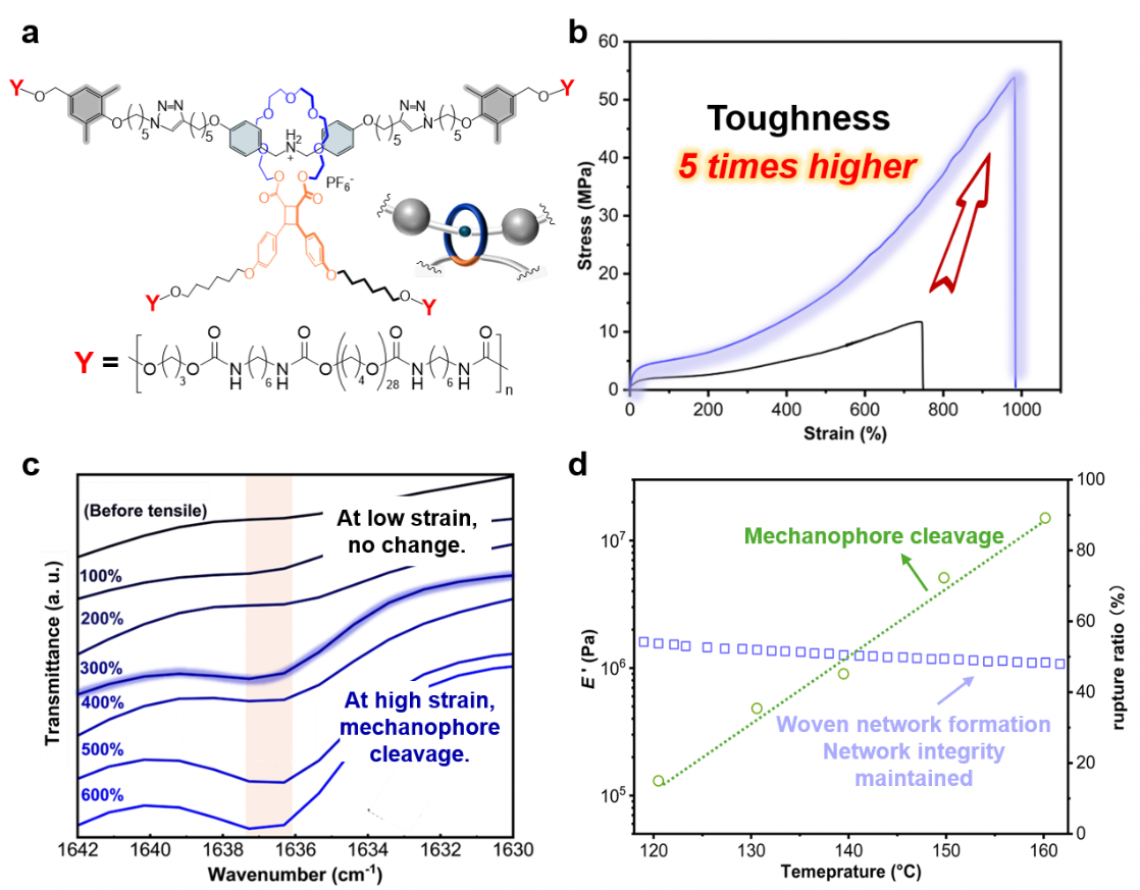
Fig. 2
(a) Molecular structure of the developed high-toughness elastomer. (b) The toughness of the elastomer is superior to that of a conventional elastomer. (c) Infrared spectroscopic analysis showing molecular structural changes in the elastomer under an applied force. (d) The elastomer maintains structural integrity through entanglement of polymer chains after bond scission.
Original content, Credit must be given to The University of Osaka. Adaptations and redistribution are permitted., The University of Osaka
About The University of Osaka
The University of Osaka was founded in 1931 as one of the seven imperial universities of Japan and is now one of Japan's leading comprehensive universities with a broad disciplinary spectrum. This strength is coupled with a singular drive for innovation that extends throughout the scientific process, from fundamental research to the creation of applied technology with positive economic impacts. Its commitment to innovation has been recognized in Japan and around the world. Now, The University of Osaka is leveraging its role as a Designated National University Corporation selected by the Ministry of Education, Culture, Sports, Science and Technology to contribute to innovation for human welfare, sustainable development of society, and social transformation.
Website: https://resou.osaka-u.ac.jp/en
Advertisement