
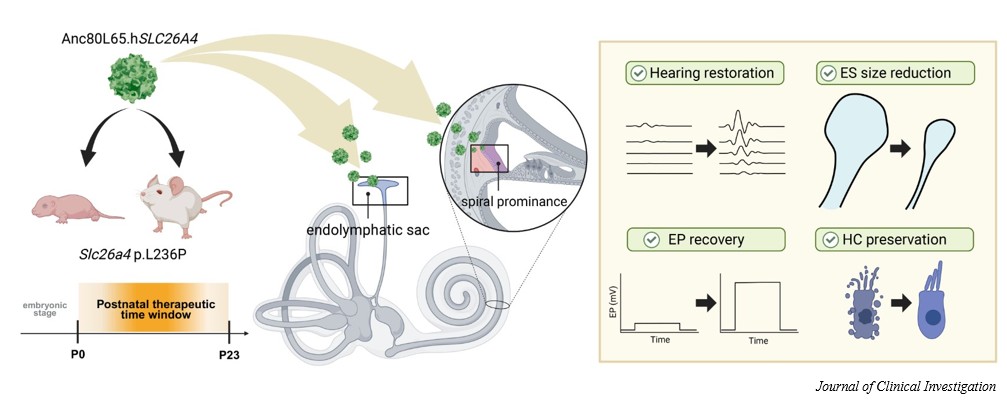

Research led by National Yang Ming Chiao Tung University and National Taiwan University uncovers a successful postnatal gene therapy strategy that restores hearing and preserves inner ear structures in a hereditary deafness model. This breakthrough identifies vital therapeutic windows after birth, paving a clear path toward clinical translation for genetic hearing loss.
An advanced synthetic viral vector successfully delivers healthy genes to critical regions of the inner ear, significantly reducing structural degeneration and restoring auditory function.
Journal of Clinical Investigation
TAIPEI, TAIWAN—Hereditary hearing loss impacts millions globally, with mutations in the SLC26A4 gene standing as one of the most common genetic triggers, particularly across Asian populations. This condition leads to severe-to-profound deafness accompanied by inner ear malformations, such as an abnormally enlarged vestibular aqueduct and endolymphatic sac.
While gene replacement therapies have long held immense potential, experimental interventions have historically been restricted to the embryonic stage. Delivering genetic material before birth presents steep ethical and practical hurdles, creating a critical roadblock for real-world medical applications.
To overcome this major limitation, a collaborative research team led by National Yang Ming Chiao Tung University and National Taiwan University investigated the therapeutic potential of gene therapy administered after birth. Utilizing a clinically precise mouse model that closely mirrors the variable hearing thresholds seen in human patients, the researchers mapped out key postnatal intervention windows. The study was published in Journal of Clinical Investigation.
The scientific team leveraged a synthetic adeno-associated virus vector, known as AAV.Anc80L65, engineered to precisely target fluid-regulating tissues within the inner ear. When the therapeutic gene was delivered during early neonatal or juvenile stages, it achieved highly efficient gene expression in the cochlea. This targeted approach significantly lowered hearing thresholds, successfully prevented sensory hair cell loss, and reduced the structural swelling of the inner ear fluid cavities into adulthood.
“By successfully correcting inner ear anomalies after birth rather than in utero, this work establishes postnatal gene therapy as a highly feasible and effective strategy for human patients,” says Dr. Chen-Chi Wu, co-corresponding author and professor of otolaryngology at National Taiwan University. “Our findings fill a critical unmet need in precision otology and give us a realistic, translationally relevant platform to prevent progressive deafness.”
The therapeutic benefits proved long-lasting, demonstrating that restoring the missing protein can stabilize the delicate electrochemical environment of the inner ear. While earlier interventions yielded the most robust outcomes, the success of the therapy during juvenile stages indicates that established genetic pathology can still be meaningfully reversed.
“Our study highlights a crucial therapeutic window during early development where the inner ear remains receptive to structural and functional rescue,” says co-corresponding author Prof. Yen-Fu Cheng at Institute of Brain Science at National Yang Ming Chiao Tung University. “This breakthrough opens new avenues for using next-generation viral vectors to treat a broad spectrum of hereditary hearing impairments safely and effectively.”
Prof. Yen-Fu Cheng's email address: [email protected]
Prof. Chen-Chi Wu's email address: [email protected]
Advertisement