
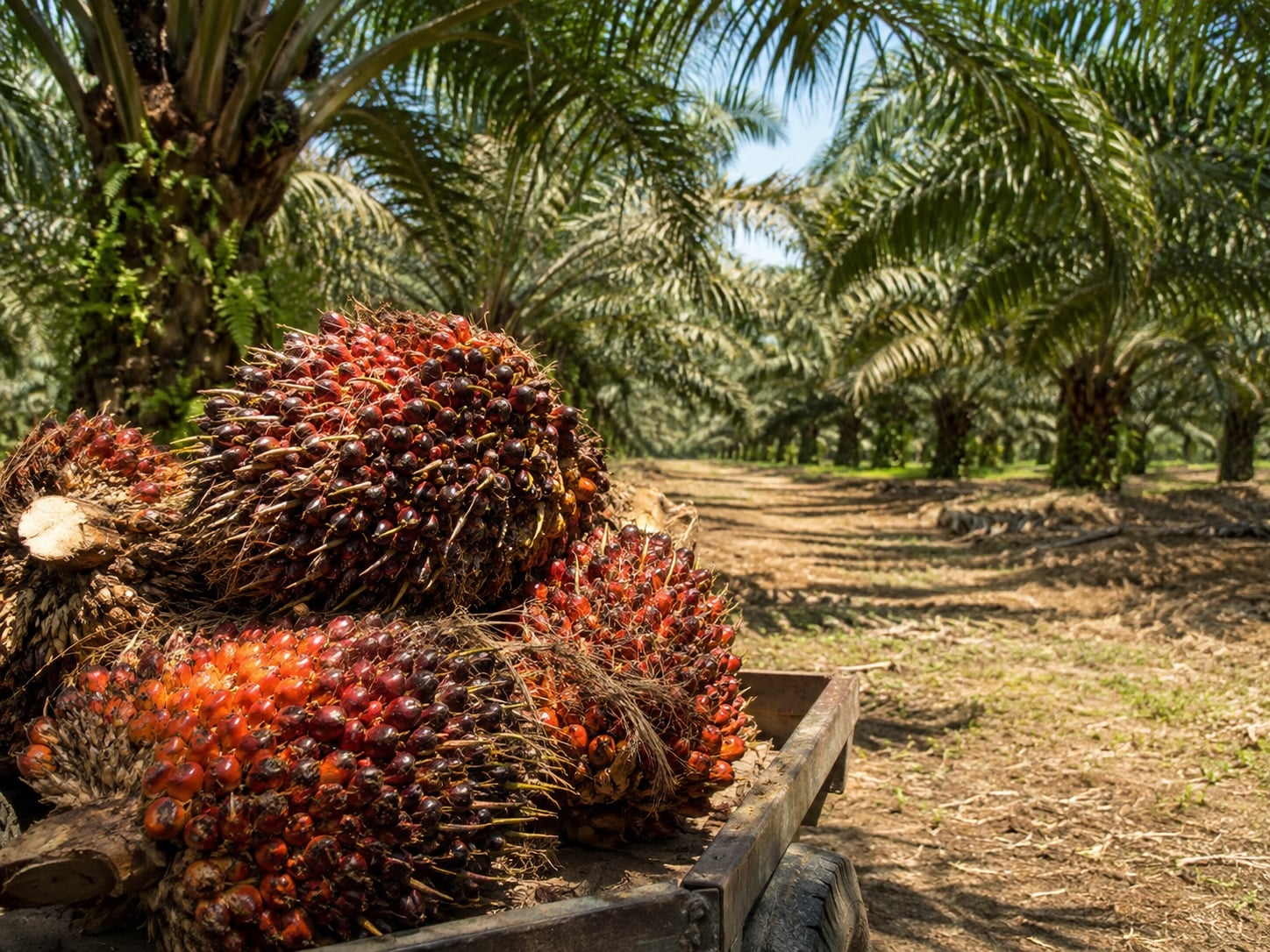
Harvesting a greener future: palm oil shows promise as a sustainable processing aid for natural rubber composites.
Researchers show that palm oil can replace aromatic oil in silica-filled natural rubber composites, supporting more sustainable rubber products without sacrificing key performance properties.
Natural rubber is widely used in tyres, transport, construction, healthcare and industrial products because of its elasticity, resilience and durability. To improve performance, rubber manufacturers often add silica fillers and processing oils. These oils help reduce viscosity, improve processing and support filler dispersion.
For decades, petroleum-derived aromatic oils have been commonly used as rubber processing oils. However, some aromatic oils contain polycyclic aromatic hydrocarbons, which are associated with health and environmental concerns. This has increased industrial interest in safer, renewable and lower-toxicity alternatives.
In a recent study, an international collaborative team from Kasetsart University in Thailand, Newcastle University in Singapore, Université de Haute-Alsace in France, and the University of South Brittany in France investigated whether palm oil could replace aromatic oil in silica-filled natural rubber composites.
The study is especially relevant to Southeast Asia, where natural rubber and palm oil are major agricultural and industrial resources. Thailand is one of the world’s leading natural rubber producers, while palm oil is widely available across the region. Using palm oil as a processing aid could therefore support local supply chains while reducing dependence on petroleum-derived additives.
The researchers compared palm oil and aromatic oil in natural rubber/silica composites prepared using a latex processing method. This method helps disperse silica more uniformly in the rubber matrix before vulcanisation, addressing a common challenge in silica-filled rubber compounds: filler aggregation.
The results showed that palm oil performed well as an alternative processing oil. Replacing aromatic oil with palm oil gave a comparable cure rate index, indicating that palm oil did not significantly disrupt the curing process. The Payne effect, which reflects filler–filler and filler–rubber interactions, was also similar for aromatic oil and palm oil systems, with values of 182 kPa and 171 kPa, respectively.
Mechanical testing showed that the palm oil-based composites had a higher Young’s modulus than the aromatic oil-based counterparts. The reinforcement index was also slightly higher for the palm oil system, suggesting improved filler–rubber interaction. Microscopy and elemental mapping showed that the latex method produced good silica dispersion in both aromatic oil and palm oil formulations.
For tyre-related applications, dynamic mechanical behaviour is particularly important. The palm oil-based composite showed the lowest tan δ value at 60 °C, a commonly used indicator of rolling resistance. A lower tan δ at this temperature suggests lower rolling resistance, which is linked to improved fuel efficiency in tyre applications. This points to a possible route for developing more sustainable rubber compounds for greener tyre technologies.
The environmental assessment showed a more nuanced picture. Compared with aromatic oil-based natural rubber latex formulations, the palm oil-based formulation reduced fossil fuel depletion, human toxicity and ozone layer depletion. The latex method also reduced human toxicity compared with the conventional dry mixing method.
However, the palm oil formulation showed higher global warming potential, eutrophication potential and freshwater aquatic ecotoxicity. These impacts are likely associated with upstream agricultural production, including fertiliser use, land-use change and agrochemical runoff. This means palm oil should not be presented as automatically “green” in every environmental category. Its benefits depend on responsible sourcing, production practices and supply-chain management.
The study therefore provides a realistic industrial message: palm oil can be a technically viable and partly lower-impact substitute for aromatic oil in natural rubber/silica composites, particularly when combined with latex processing. It may help reduce reliance on petroleum-derived aromatic oils while maintaining rubber performance, but sustainability gains will depend on how the palm oil is produced.
The findings are relevant to rubber manufacturers, tyre compounders, materials suppliers and sustainability teams seeking renewable processing aids for rubber products. They also point to opportunities for Southeast Asian industries to create higher-value applications from regional bio-based resources.
The paper, “Substitution of Aromatic Oil with Palm Oil in Natural Rubber/Silica Composites via Latex Processing”, is published in ACS Omega. DOI: 10.1021/acsomega.6c02667.
Authors and affiliations
The study was carried out by Hassarutai Yangthong, Papawarin Udomsin, Phakamat Lim-arun, Supitta Suethao and Wirasak Smitthipong from Kasetsart University, Thailand; Pornsiri Kaewpradit from Prince of Songkla University, Thailand; Pairote Jittham and Sedthawatt Sucharitpwatskul from the National Metal and Materials Technology Center, Thailand; Karine Mougin and Arnaud Spangenberg from Université de Haute-Alsace/CNRS, France; Antoine Le Duigou from the University of South Brittany/CNRS, France; and Kheng Lim Goh from Newcastle University in Singapore.
For further details, please contact:
Dr Wirasak Smitthipong at [email protected]
Dr Kheng Lim Goh at [email protected]
Advertisement