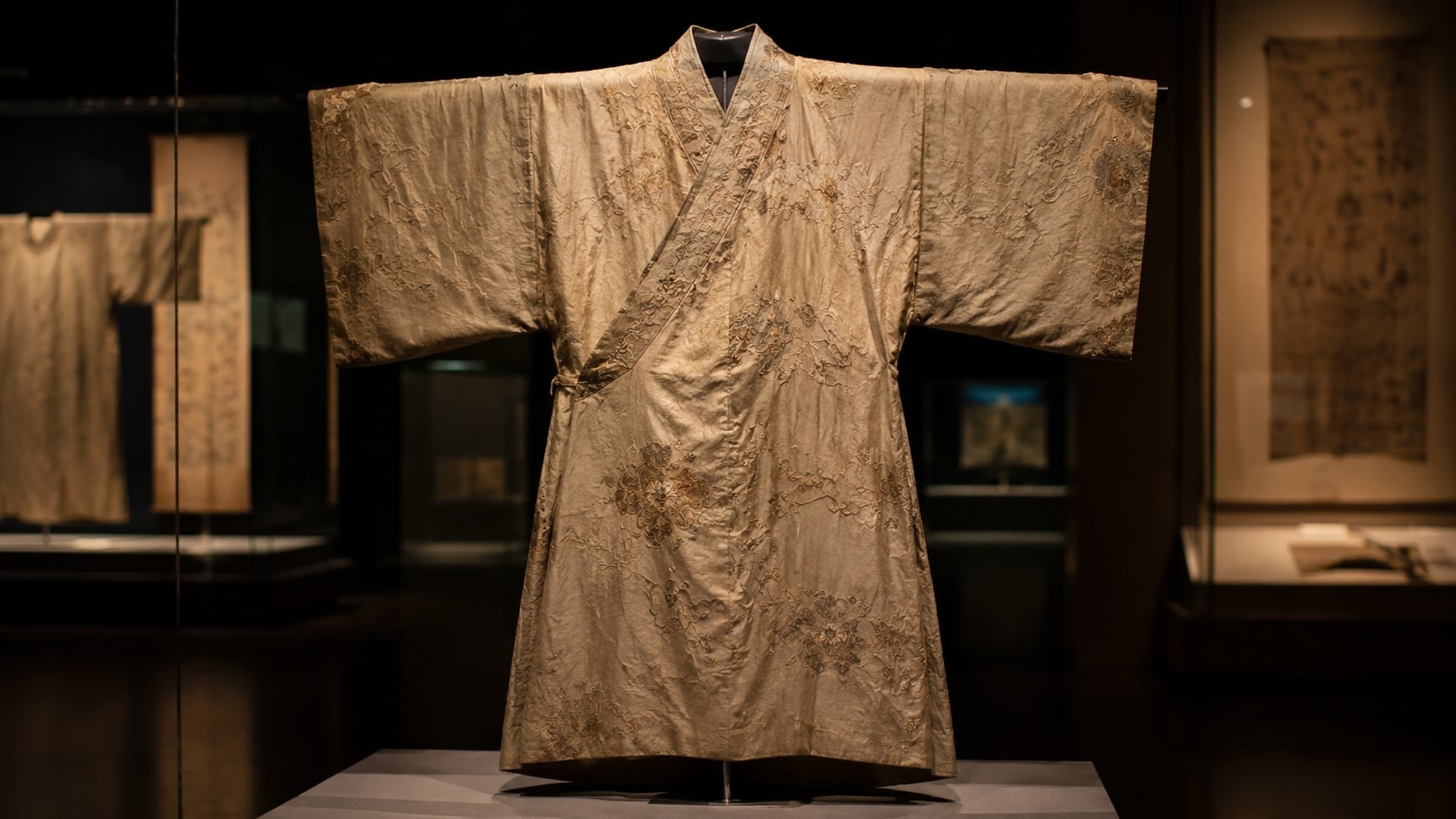
A historic silk robe displayed in a museum highlights the challenge of preserving fragile organic materials while limiting further damage.
Museums, libraries, archives and heritage organisations face a difficult problem: many of the objects they preserve are made from materials that naturally deteriorate.
Silk weakens and yellows. Leather and parchment lose collagen integrity. Paper becomes brittle and acidic. Wood can decay through moisture, microorganisms and chemical reactions.
A new international review brings together recent advances in identifying, monitoring and protecting these organic cultural materials. It focuses on silk, leather, parchment, paper and wood, and examines how modern analytical tools and new conservation materials can support better decisions across the heritage sector.
The review was prepared by researchers from Zhengzhou University and the Palace Museum in China, the INCDTP–Leather and Footwear Research Institute in Romania, and Newcastle University in Singapore.
Diagnosing damage before intervention
The review shows that conservation is moving away from relying only on visible signs of deterioration.
Modern tools can now identify changes in molecular structure, crystallinity, chemical composition, thermal stability and microbial activity. These include infrared and Raman spectroscopy, X-ray diffraction, solid-state nuclear magnetic resonance, electron microscopy, mass spectrometry and DNA-based sequencing.
For heritage organisations, the main industry opportunity lies in combining these methods into practical diagnostic systems.
Portable spectrometers can support rapid on-site assessment. Imaging systems can reveal surface damage. Omics tools can identify microorganisms responsible for biodeterioration. Data from several techniques can then be combined to distinguish surface damage from deeper structural change.
The review argues that no single method is sufficient. The most reliable assessment comes from combining complementary tools while keeping sampling to a minimum.
This creates opportunities for:
- portable and non-destructive analytical instruments;
- integrated heritage-monitoring platforms;
- environmental sensing and predictive maintenance;
- data-analysis software for conservation decisions; and
- specialist services that combine materials analysis with conservation planning.
Why organic heritage deteriorates
Despite their different structures, silk, collagen-based materials and cellulose-based materials share two major deterioration pathways: oxidation and hydrolysis.
Temperature, humidity, ultraviolet light, air pollutants and microorganisms can accelerate these reactions. Over time, they alter the molecular structure and weaken the material.
The review highlights that damage often starts in the less ordered regions of silk and paper before spreading into more crystalline regions. Leather and parchment are especially vulnerable because collagen can lose its triple-helical structure through heat, humidity, acidity and biological attack.
For industry, this means that preservation cannot rely on a single environmental threshold or one universal treatment. Monitoring and intervention must be tailored to the material, its condition and the cause of deterioration.
A shift towards reversible and biobased materials
Traditional conservation treatments often involve adhesives, coatings or consolidants placed directly onto fragile objects. These can strengthen the material, but they may also alter its appearance, trap moisture or become difficult to remove later.
The review identifies growing interest in biopolymer-based and nanostructured materials that are more compatible with heritage substrates.
Examples include:
- silk fibroin and bacterial cellulose for reinforcing historic silk;
- collagen-based nanomaterials for deteriorated leather;
- mineralised bacterial cellulose for paper deacidification;
- chitosan and plant-derived compounds for antimicrobial protection;
- cellulose nanofibres and silica-based coatings for wood; and
- transparent coatings designed to block water, pollutants or ultraviolet light.
These developments are particularly relevant to manufacturers of coatings, membranes, adhesives, hydrogels, nanomaterials and bio-based polymers.
However, the review stresses that performance alone is not enough. Conservation materials should also be removable, compatible with the original object and stable over long periods.
A treatment that works initially but yellows, hardens or becomes impossible to remove may create a future conservation problem.
Protecting objects without touching them
Contactless protection is another important direction.
The review examines physical methods such as gamma irradiation, ultraviolet treatment, low-temperature plasma and low-oxygen environments. It also considers protective coatings placed on display glass rather than on the heritage object itself.
These approaches can reduce microbial growth, acidity, ultraviolet exposure and pollutant damage while avoiding direct contact with fragile surfaces.
For museums and technology providers, this opens up a market for:
- treated display cases and protective glazing;
- controlled-atmosphere storage;
- plasma-based deacidification and sterilisation;
- non-contact antimicrobial systems; and
- environmental control systems linked to real-time monitoring.
The limitation is that contactless methods cannot yet meet every conservation need. They are less suited to structural reinforcement and may provide weaker protection than a coating placed directly on the object.
The review therefore presents contact and contactless approaches as complementary rather than competing solutions.
What industry should focus on next
The authors identify four priorities for the next generation of heritage technology.
First, analytical methods must become less destructive. Some existing techniques still require samples to be removed or consumed.
Second, conservation needs closer collaboration among materials scientists, chemists, microbiologists, historians, conservators and data specialists.
Third, future protective materials should be preventive, removable and environmentally responsible.
Fourth, treatment should be targeted. The correct solution depends on whether the damage is caused by heat, moisture, light, pollution, microorganisms or a combination of these factors.
For industry-facing readers, the central message is clear: heritage conservation is becoming a high-value materials and diagnostics field.
The strongest commercial opportunities will not come from selling a single coating or instrument. They will come from systems that combine diagnosis, monitoring, material compatibility, reversibility and long-term performance.
Paper details
The review, “Identification, deterioration, and protection of organic cultural heritages from a modern perspective”, was published in npj Heritage Science in 2025.
DOI: 10.1038/s40494-025-01601-5.
International collaboration
The review involved researchers from:
- Zhengzhou University, China;
- the Palace Museum, Beijing, China;
- the INCDTP–Leather and Footwear Research Institute, Romania; and
- Newcastle University in Singapore.
For further details, contact Professor Keyong Tang, Zhengzhou University, at [email protected], or Dr Kheng-Lim Goh, Newcastle University, at [email protected].
Advertisement