
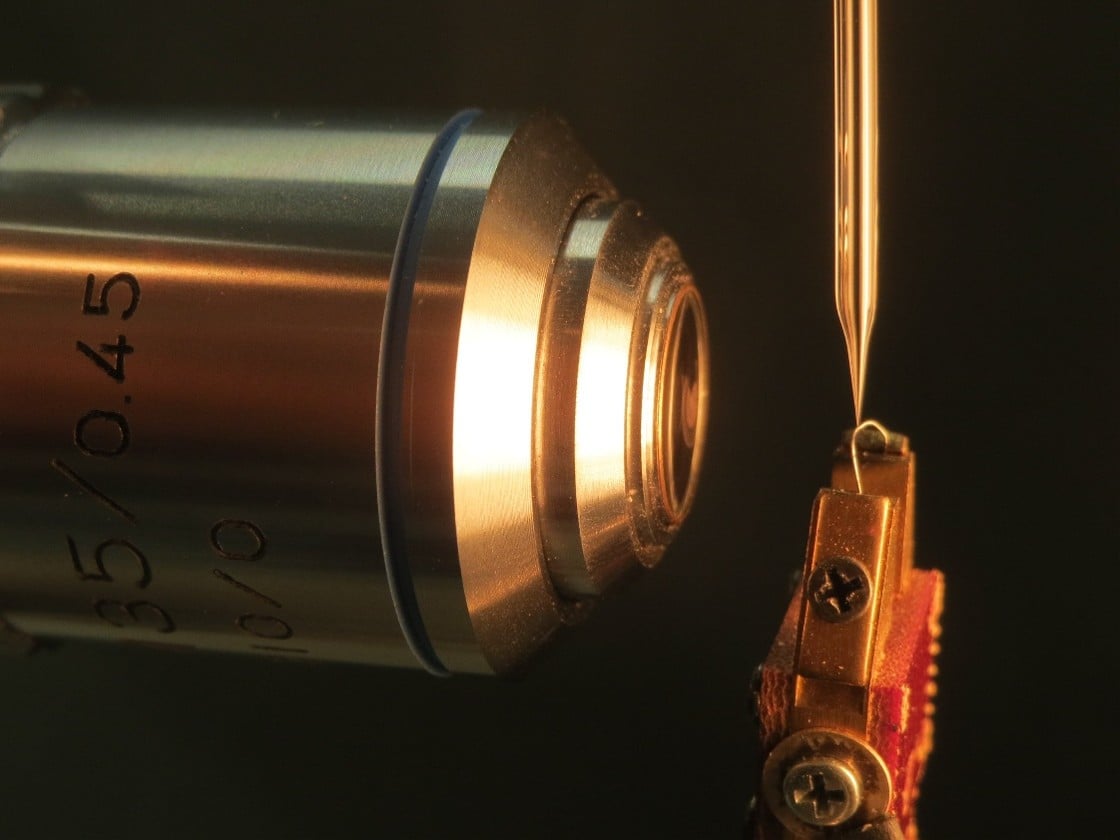
A glass microelectrode used in organelle electrophysiology. Using whole-lysosome patch-clamp recording, the researchers directly measured ion currents from individual lysosomes and found that O-linked sugar chains act as a molecular brake on the ion channel TPC2.
Lysosomes are small compartments inside cells that break down and recycle biological materials. Once regarded mainly as cellular waste-disposal centers, lysosomes are now understood to be important signaling hubs for calcium and sodium ions. Through these signals, they help regulate intracellular transport, organelle shape and cellular responses associated with disease.
An international research team led by the Department of Clinical Laboratory Sciences and Medical Biotechnology at National Taiwan University College of Medicine has discovered a previously unknown mechanism that controls a lysosomal ion channel called two-pore channel 2, or TPC2. The study is published in Nature Communications.
The researchers found that small sugar chains attached to TPC2 act like a molecular brake. These modifications, known as mucin-type O-linked glycans, are located on the part of the channel facing the interior of the lysosome. Rather than serving only as structural decoration, the sugar chains restrict channel opening and limit the movement of calcium and sodium ions across the lysosomal membrane.
To measure TPC2 activity directly, the team used whole-lysosome patch clamp, a technically demanding form of organelle electrophysiology. In this method, individual lysosomes are enlarged, isolated from the cell and electrically recorded using a microscopic glass electrode. The researchers combined this approach with calcium nanodomain imaging, genetic modification, molecular dynamics simulations, super-resolution microscopy and small-molecule pharmacology.
The team identified two amino acids, Ser612 and Ser613, as key sites involved in this sugar-dependent regulation. Shortening the glycans, disrupting their synthesis or replacing these amino acids caused TPC2 to become more active, resulting in larger calcium and sodium currents.
Removing the sugar brake also changed lysosomal behavior. Lysosomes became more mobile, formed elongated tubular structures and showed increased clustering of TPC2. In disease-related cell models, loss of normal glycan regulation was also associated with increased cell migration and adhesion. These effects could be reduced by compounds that inhibit TPC2, supporting a causal connection between TPC2 activity, lysosomal remodeling and cellular behavior.
TPC2 dysfunction has previously been linked to viral infections, neurodegenerative disorders and cancer. Abnormal glycosylation is also common in many disease states. By connecting these two processes, the study provides a new molecular framework for understanding how altered glycosylation may disrupt lysosomal electrical signaling and organelle function in disease.
The ability to suppress glycan-deficient TPC2 hyperactivity with small-molecule inhibitors also highlights the potential of this regulatory mechanism for future drug development. In the longer term, understanding disease-associated changes in TPC2 glycosylation and activity may help inform precision-medicine strategies targeting lysosomal ion channels.
“Glycosylation is often regarded mainly as a structural modification of proteins. Our findings show that, in TPC2, these sugar chains act as an active braking system that controls lysosomal excitability and remodeling,” says corresponding author Prof. Cheng-Chang Chen of the Department of Clinical Laboratory Sciences and Medical Biotechnology at National Taiwan University College of Medicine.
“By combining advanced lysosomal electrophysiology with the complementary expertise of an interdisciplinary and international team, we have gained a deeper understanding of how TPC2 is regulated in both physiological and disease-related contexts. TPC2 is a lysosomal ion channel considered a promising therapeutic target for several human diseases, and clarifying its regulatory mechanisms is an important step toward developing more selective ways to modulate its activity,” Chen says.
The work was a collaboration between groups at National Taiwan University College of Medicine, National Taiwan University Hospital, Tzu Chi University, Ludwig-Maximilians University of Munich, and University of Oxford.
Prof. Cheng-Chang Chen's email address: [email protected]