
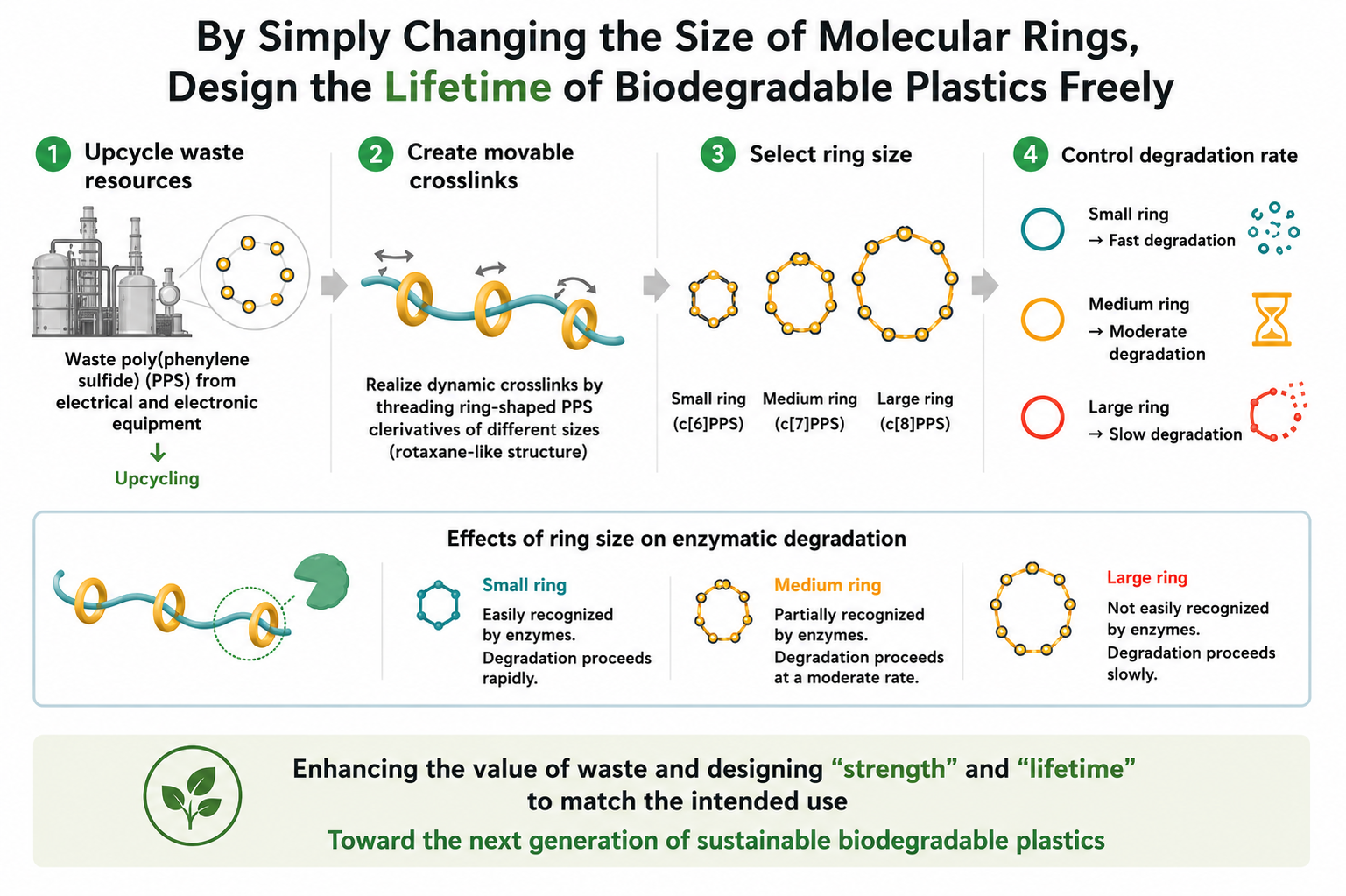

Researchers at the University of Osaka used cyclic PPS manufacturing by-products as movable molecular crosslinks in biodegradable PCL. Medium-sized c [7] PS rings approximately doubled toughness while slowing enzymatic degradation, whereas larger c [9] PS rings accelerated degradation to no residual film mass after 48 hours. The findings identify molecular ring size as a design parameter for tuning material lifetime while also offering a waste-to-value route toward more sustainable polymer systems with programmable properties.
Cyclized poly(phenylene sulfide) (c[n]PS), a byproduct of PPS production, was incorporated into a biodegradable plastic as movable crosslinkers.
Simply varying the molecular ring size enables control over both material toughness and the rate of enzymatic degradation, allowing the material lifetime to be tailored.
Original content, Credit must be given to the creator., Yoshinori Takashima
Movable molecular rings derived from an industrial by-product strengthen biodegradable polycaprolactone while controlling its enzymatic degradation rate.
Osaka, Japan - Biodegradable plastics should be tough enough for use, yet able to break down at an appropriate rate afterward. Researchers at the University of Osaka showed that changing the size of rings threaded onto a biodegradable polymer can tune both its toughness and enzymatic degradation, offering a way to design material lifetimes. This study was accepted for publication in ACS Sustainable Chemistry & Engineering.
Polycaprolactone (PCL) is a biodegradable polyester with potential applications in sustainable materials. However, conventional methods used to improve its mechanical performance, such as blending and copolymerization, can alter the molecular structure and chain packing that govern degradation. It has therefore remained difficult to combine practical toughness with controllable end-of-life behavior. To address this challenge, the researchers investigated whether movable molecular crosslinks could reinforce PCL while allowing its degradation rate to be tuned through molecular design.
The team focused on cyclic poly (phenylene sulfide), c[n]PS, an industrial by-product of poly (phenylene sulfide) (PPS) production. They isolated three ring sizes—c [5] PS, c [7] PS, and c [9] PS - and incorporated them into PCL through solvent-free ring-opening polymerization. As PCL chains formed through the rings, pseudorotaxane-based “movable crosslinks” were created. These rings can slide along polymer chains, helping redistribute stress and dissipate energy.
At 0.5 wt%, c [7] PS nearly doubled PCL toughness while preserving its Young’s modulus and thermoplastic reprocessability. Ring size also strongly affected enzymatic degradation: c [5] PS modestly accelerated degradation, c [7] PS slowed it, and c [9] PS degraded fastest, with no residual film mass after 48 hours. Control samples without movable crosslinks did not show the same ring-size dependence. The results are consistent with a mechanism in which ring size changes polymer-chain mobility and the accessibility of amorphous regions to enzymatic attack.
This approach could help create biodegradable plastics that remain durable during use but degrade at a rate suited to their intended end-of-life pathway. It also upcycles a PPS manufacturing by-product into a supramolecular material, supporting circular use of polymer resources.
Senior author Professor Yoshinori Takashima noted that making materials durable and making them break down quickly may seem like contradictory goals. He hopes to control both so polymer lifetimes can be tailored to different applications.
###
The article, “Upcycling Waste Cyclic Poly(phenylene sulfide) as Valuable Movable Crosslinkers for Toughening and Ring-Size-Controlled Enzymatic Degradation of Polycaprolactone” was published in ACS Sustainable Chemistry & Engineering at DOI: https://doi.org/10.1021/acssuschemeng.6c05417
About The University of Osaka
The University of Osaka was founded in 1931 as one of the seven imperial universities of Japan and is now one of Japan's leading comprehensive universities with a broad disciplinary spectrum. This strength is coupled with a singular drive for innovation that extends throughout the scientific process, from fundamental research to the creation of applied technology with positive economic impacts. Its commitment to innovation has been recognized in Japan and around the world. Now, The University of Osaka is leveraging its role as a Designated National University Corporation selected by the Ministry of Education, Culture, Sports, Science and Technology to contribute to innovation for human welfare, sustainable development of society, and social transformation.
Website: https://resou.osaka-u.ac.jp/en
Advertisement
Advertisement