

New Horizons in Sensitivity Assessment: Integrating Genetic Sequence Comparison, Machine Learning, In Silico, and In Vitro Analyses of Mammalian Estrogen Receptors
【Why do animals react differently to chemicals?】
The relationship between mammalian ecological factors, estrogen receptor alpha structure, and chemical sensitivity
Hisato Iwata
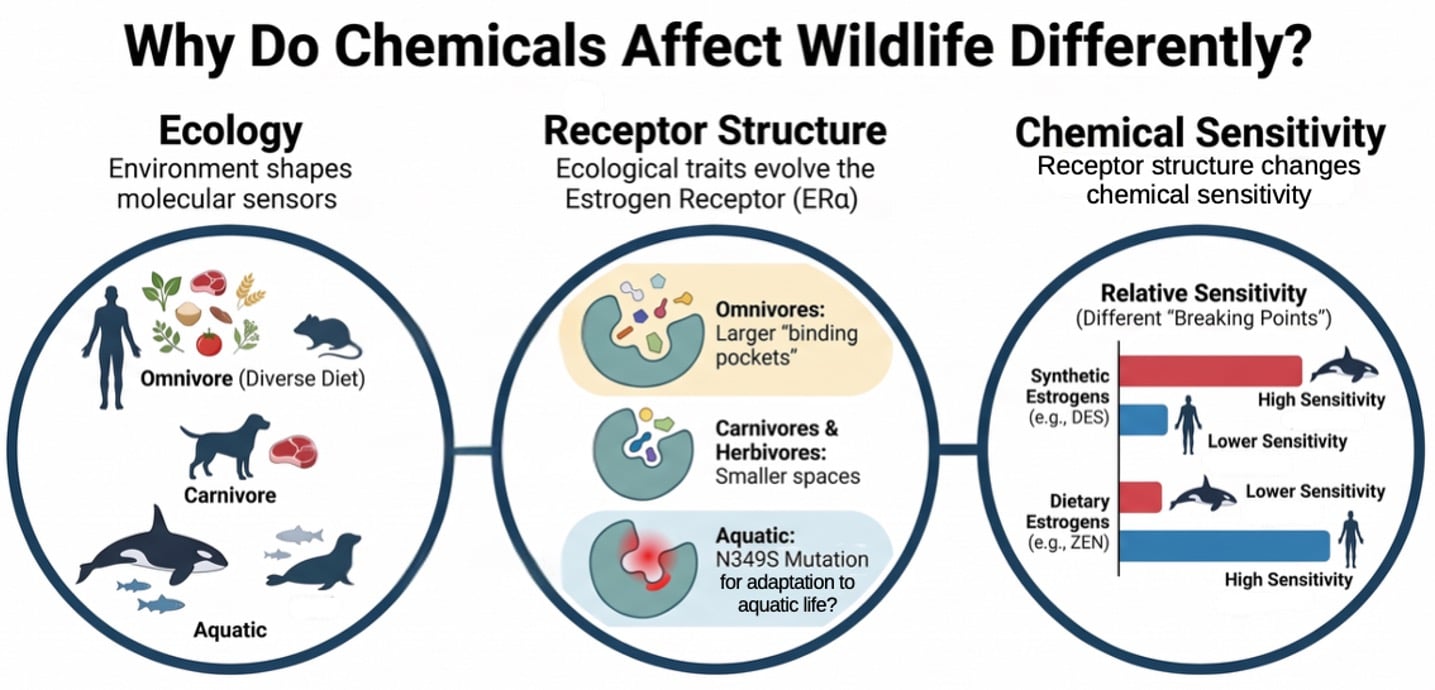
Chemicals affect different biological species in different ways, presenting a major challenge in assessing environmental chemical risks. However, the precise mechanisms determining these species differences have remained largely unknown. To address this, the research team focused on estrogen receptor alpha (ERα) and used "New Approach Methodologies (NAMs)"—an advanced framework combining genetic sequence analysis (bioinformatics), computer-based 3D structural modeling (in silico analysis), artificial intelligence (AI/machine learning), and cell-based experiments (in vitro assays). Through this integrated approach, they comprehensively revealed how ecological differences across mammals and amino acid variations in ERα influence chemical responsiveness.
Analyzing the relationship between ERα sequences from 169 mammalian species and 107 ecological traits—such as diet, habitat, and reproductive strategy—revealed distinct groupings aligned with the animals' lifestyles. Furthermore, 3D structural analysis of ERα protein showed that omnivorous animals tend to have larger "binding pockets"—where chemicals fit into the receptor—compared to carnivores and herbivores.
In addition, cell-based experiments targeting ERα from six mammalian species demonstrated marked interspecies differences in sensitivity to natural and synthetic estrogenic chemicals. Notably, in cetaceans (whales and dolphins), a unique mutation was discovered where the 349th amino acid of ERα was substituted from asparagine (in human ERα) to serine. This mutation alters the structure of ERα and is linked to aquatic adaptation and changes in chemical responsiveness.
Furthermore, model analysis powered by AI (machine learning) identified the "brain-to-body mass ratio" (the ratio of brain weight to total body weight) as a promising factor for predicting variations in ERα structure and differences in chemical sensitivity.
This study identifies key ecological and ERα structural factors that dictate species-specific chemical sensitivities in different animals. Ultimately, these findings reveal the underlying molecular mechanisms required to predict chemical risks to wildlife with high precision.
Advertisement