
Fig. 1
Summary of this study
New mouse models developed at the University of Osaka show why dental symptoms can differ between patients and may help guide more tailored dental care
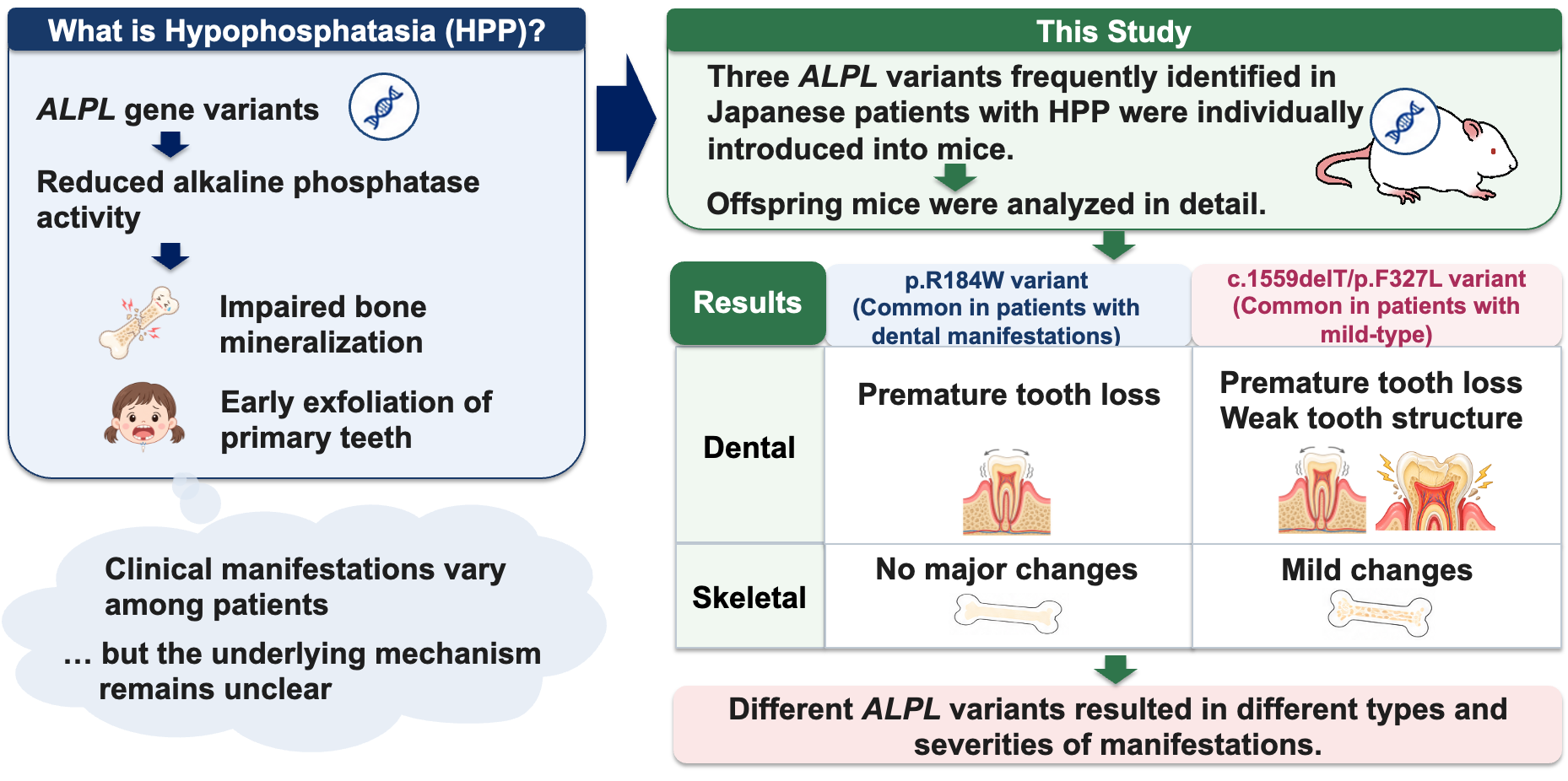
Osaka, Japan – In hypophosphatasia, a rare inherited condition that weakens bones and teeth, early tooth loss can be the first, or even the only obvious sign. Yet why dental symptoms differ so much between patients has remained unclear. Researchers at the University of Osaka have developed new mouse models that reproduce genetic changes seen in patients, revealing that teeth and their supporting tissues can be affected even when changes in the rest of the skeleton are mild.
The team introduced three variants of the ALPL gene found in patients and closely analyzed two models representing milder forms of the disease. Both showed reduced density of the bone surrounding the teeth and weaker tissues that anchor teeth in place. One model, carrying the p.R184W variant, showed little obvious skeletal change elsewhere but abnormalities in dentin, cementum, and tooth-supporting tissues. The other, carrying c.1559delT and p.F327L, showed mild skeletal changes together with broader dental defects, including reduced mineralization of enamel and dentin and thinner dentin.
Importantly, the differences in dental symptoms could not be explained by blood levels of tissue-nonspecific alkaline phosphatase (TNAP) alone. TNAP is an enzyme needed for proper hardening of bones and teeth. The findings indicate that the specific ALPL variant itself also influences how oral symptoms develop.
“Some patients are diagnosed only after their baby teeth fall out early, even though they show almost no bone symptoms,” says Associate Professor Rena Okawa. “We hope these models will help us develop dental treatments tailored to each patient’s symptoms.”
The models could provide a platform for studying ways to prevent tooth loss, protect the jawbone around teeth, and improve the safety of dental treatments such as orthodontics. Because dental symptoms can appear before obvious skeletal problems, the work also highlights the potential role of dentists in earlier recognition of the disease.
###
The study, supported in part by a crowdfunding campaign involving 443 donors, was published in JBMR Plus on August 25, 2026 at DOI:
https://doi.org/10.1093/jbmrpl/ziag147
About The University of Osaka
The University of Osaka was founded in 1931 as one of the seven imperial universities of Japan and is now one of Japan's leading comprehensive universities with a broad disciplinary spectrum. This strength is coupled with a singular drive for innovation that extends throughout the scientific process, from fundamental research to the creation of applied technology with positive economic impacts. Its commitment to innovation has been recognized in Japan and around the world. Now, The University of Osaka is leveraging its role as a Designated National University Corporation selected by the Ministry of Education, Culture, Sports, Science and Technology to contribute to innovation for human welfare, sustainable development of society, and social transformation.
Website: https://resou.osaka-u.ac.jp/en