
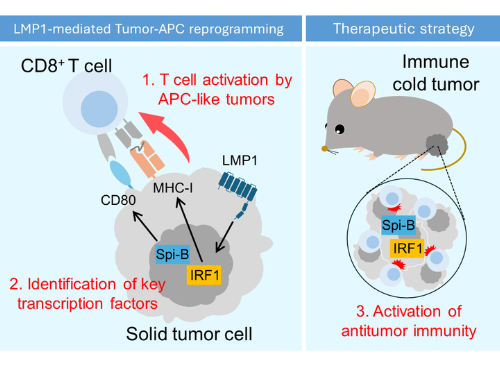

LMP1, an Epstein-Barr virus protein, has a “Mr. Hyde” side that can promote cancer and a “Dr. Jekyll” side that can spur antitumor immune responses. In a study published in Cell Reports, researchers traced key parts of that antitumor effect to the transcription factors Spi-B and IRF1, then showed that expressing the two without LMP1 activated CD8+ T cells and suppressed tumor growth in mice.
LMP1 enhances tumor immunogenicity through Spi-B and IRF1
LMP1 activates Spi-B and IRF1 in tumor cells, promoting MHC class I and CD80 expression and enhancing CD8+ T-cell-mediated antitumor immunity. This mechanism suggests a potential strategy for turning immune-cold tumors into immunologically active tumors.
Tomoharu Yasuda / Hiroshima University
Scientists at Hiroshima University (HU) have traced key antitumor immune effects of LMP1, a cancer-promoting Epstein-Barr virus protein, to two transcription factors, Spi-B and IRF1, and found that expressing the two together made tumor cells easier for the immune system to recognize and better able to activate CD8+ T cells without using the viral protein itself.
The findings, published in Cell Reports, build on an unusual property of LMP1. Previous research showed that the viral protein can drive cancer-related changes in infected B cells, which are immune cells best known for producing antibodies, while also making them easier for T cells to recognize and eliminate.
The researchers asked whether LMP1 could produce similar immune effects in solid tumor cells and which downstream factors were responsible. "LMP1 has two contrasting faces, much like Dr. Jekyll and Mr. Hyde," said corresponding author Tomoharu Yasuda, professor at HU's Graduate School of Biomedical and Health Sciences.
In laboratory experiments, LMP1 increased MHC class I, which displays antigen fragments on the surface of cells for CD8+ T cells to recognize, across several solid tumor cell lines. It also increased molecules involved in T cell activation in some tumor models. In mouse melanoma cells, LMP1 also increased the presentation of antigens derived from endogenous retroviruses — remnants of ancient viral infections embedded in the genome — helping activate tumor-reactive CD8+ T cells.The researchers then traced key parts of LMP1’s immune effects to two transcription factors, proteins that control the activity of other genes, called Spi-B and IRF1.
Spi-B increased CD80, which provides a signal that helps activate T cells, while IRF1 increased MHC class I, which displays antigens for CD8+ T cells to recognize. Together, the two factors made tumor cells better able to present antigens and stimulate CD8+ T-cell responses.
Expressing Spi-B and IRF1 together reproduced key immune effects of LMP1 without requiring the cancer-promoting viral protein itself. Expressing both factors increased CD8+ T-cell responses and suppressed tumor growth in mice.
“In a sense, we have found a way to bring out Dr. Jekyll while leaving Mr. Hyde behind,” Yasuda said.
The findings point to a possible way to make tumors that provoke weak immune responses easier for the immune system to recognize and better able to activate T cells. The approach remains experimental. The tumor-suppression results were demonstrated in mice, and the specific endogenous-retrovirus antigen examined was mouse-specific. Further studies will be needed to determine whether targeting Spi-B and IRF1 can produce similar effects safely and effectively in human tumors.
The researchers now plan to develop a messenger RNA, or mRNA, approach to deliver Spi-B and IRF1 into tumors. Their goal is to test whether the two factors can strengthen antitumor immune responses without introducing LMP1 itself.
###
About Hiroshima University
Since its foundation in 1949, Hiroshima University has striven to become one of the most prominent and comprehensive universities in Japan for the promotion and development of scholarship and education. Consisting of 12 schools for undergraduate level and 5 graduate schools, ranging from natural sciences to humanities and social sciences, the university has grown into one of the most distinguished comprehensive research universities in Japan. English website: https://www.hiroshima-u.ac.jp/en
Advertisement