


A research team led by Associate Professor Yasuo Murayama of Kanazawa University identified longitudinal associations among loneliness, depressive symptoms, and social behaviors in children affected by the 2024 Noto Peninsula Earthquake. The findings highlight the importance of integrated mental health support for children in disaster-affected communities.
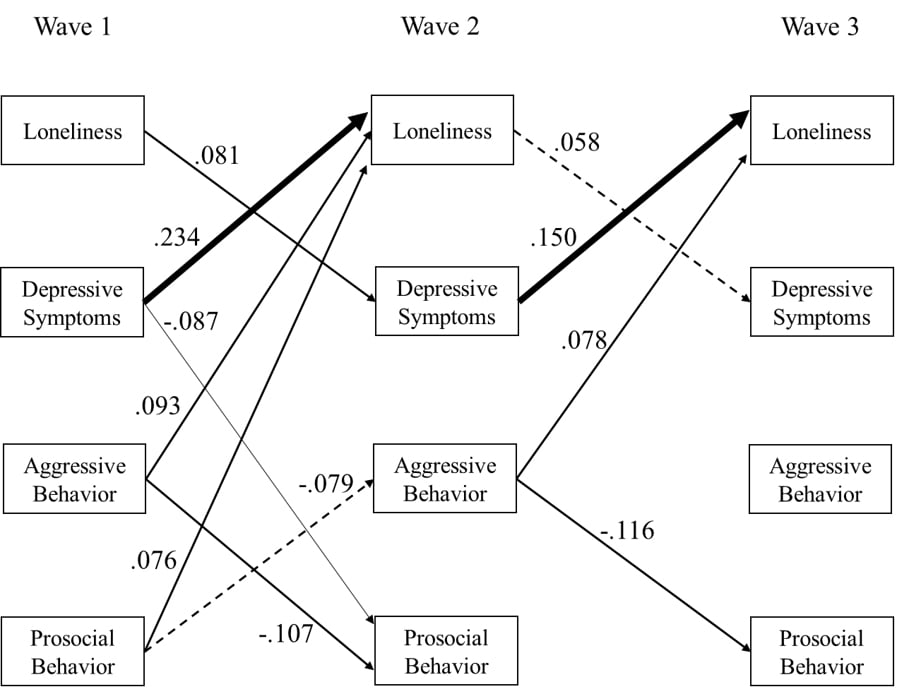
Figure. Cross-lagged panel model illustrating significant longitudinal associations among loneliness, depressive symptoms, aggressive behavior, and prosocial behavior across three waves. Standardized coefficients (β) are presented. Thicker lines indicate large effect sizes (β > .12), based on the criteria proposed by Orth et al. (2024). Dashed lines represent marginally significant paths (p < .10). For clarity, autoregressive paths across waves (including additional paths from Wave 1 to Wave 3), paths from the control variables (gender and grade), and residual correlations among variables at Waves 2 and 3 are omitted from the figure.
Murayama et al., Child Psychiatry and Human Development (2026), CC BY 4.0
A research team led by Associate Professor Yasuo Murayama of Kanazawa University has identified important longitudinal associations among loneliness, depressive symptoms, and social behaviors in children affected by the 2024 Noto Peninsula Earthquake.
The study followed 634 students in grades 3 through 9 (303 boys and 331 girls) in Wajima City, Ishikawa Prefecture, which was severely affected by the earthquake. Surveys were conducted in July and October 2024 and February 2025. Using a cross-lagged panel model, the researchers examined the longitudinal relationships among loneliness, depressive symptoms, aggressive behavior, and prosocial behavior.
The findings revealed that higher levels of depressive symptoms and aggressive behavior were associated with greater loneliness at subsequent time points. Bidirectional associations were also observed between loneliness and depressive symptoms, with depressive symptoms showing a stronger and more consistent association with later loneliness than the reverse pathway. Aggressive behavior was also associated with lower subsequent prosocial behavior.
From Research Findings to Real-World Support
"First and foremost, I feel relieved that our study has been accepted for publication," said Murayama. "But behind these findings are children struggling with mental health difficulties in schools, and teachers who are doing their best to support them while facing difficult questions about how to help. As a psychologist, I hope to translate these findings into meaningful support for children."
The findings highlight the importance of addressing children's emotional, behavioral, and interpersonal difficulties together, rather than treating them as separate problems. In disaster-affected communities, sustained mental health support should consider not only visible behavioral difficulties but also less visible challenges, such as loneliness and depressive symptoms.
Although the study does not establish the causal effects of disaster exposure, it provides valuable insights into the interconnected psychological and behavioral difficulties experienced by children living in a severely disaster-affected community.
The study was published in the international peer-reviewed journal Child Psychiatry & Human Development on September 11, 2026
Advertisement