

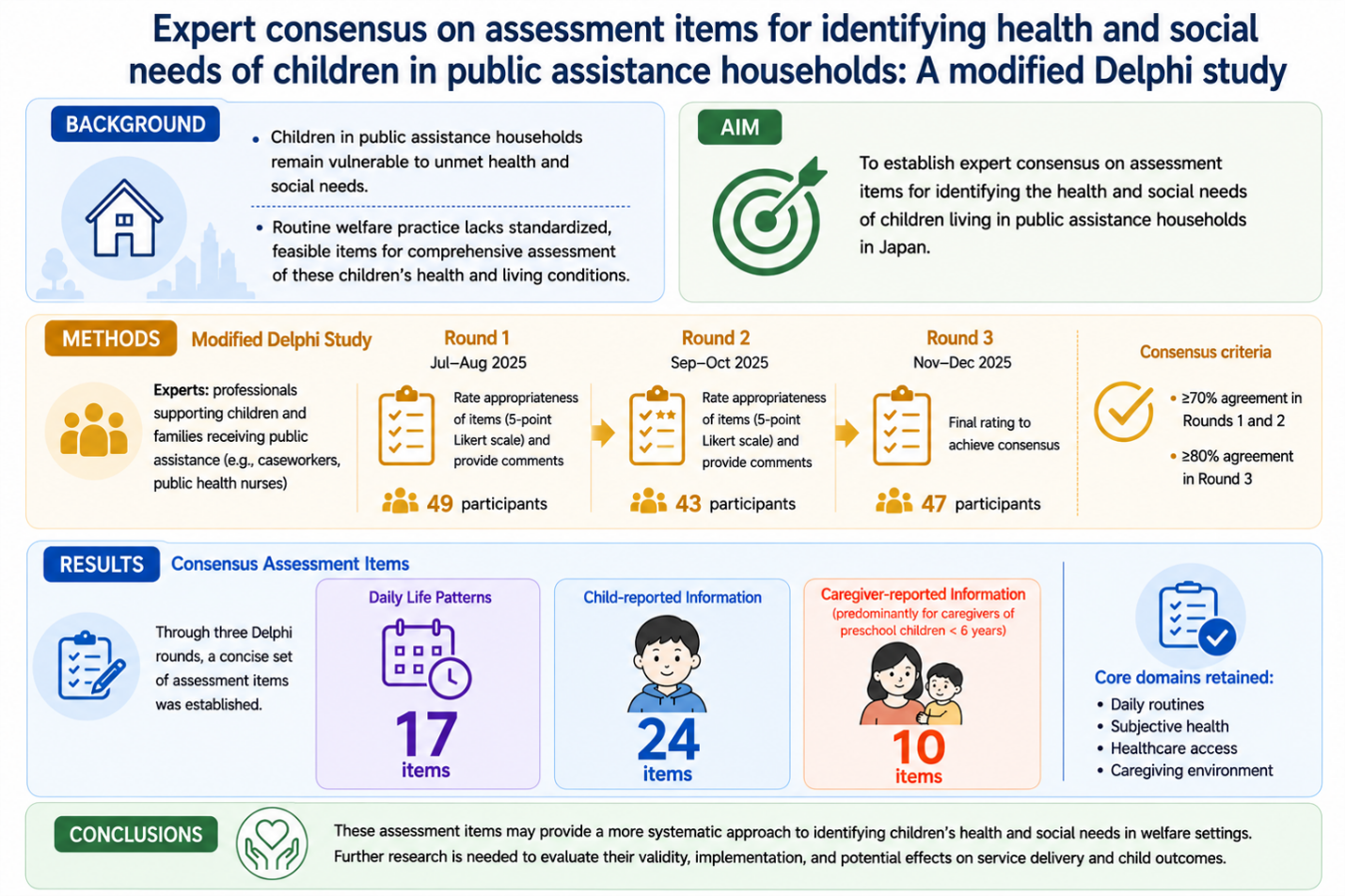

Researchers at Kanazawa University and Kobe University proposed a set of assessment items to identify the health and living conditions of children living in public assistance households. Developed through a three-round modified Delphi study involving welfare professionals from nine municipalities across Japan, the items are intended to support a shared framework for child support and information sharing in municipal welfare practice.
Figure 1. Overview of the study
K. Ueno, Kanazawa University, 2026
A research group led by Assistant Professor Keiko Ueno of the Innovative Clinical Research Center, Kanazawa University, and Associate Professor Daisuke Nishioka of the Graduate School of Medicine, Kobe University, has proposed a set of assessment items (*1) for identifying the health and living conditions of children living in public assistance households, with future use in municipal welfare practice.
Children living in public assistance households may face challenges in a range of areas, including health, daily routines, school life, and the family environment. However, municipal welfare settings have lacked a sufficiently standardized set of assessment items for identifying and evaluating these circumstances from a shared perspective.
In this study, the researchers conducted three rounds of a modified Delphi study (*2) among 49 professionals, including caseworkers and public health nurses, who support children including those living public assistance, at welfare offices and related organizations in nine municipalities across Japan. By repeatedly incorporating participants’ ratings and comments and consolidating items the researchers established a set comprising 17 items on daily life patterns, 24 questions for child-reported information, and 10 questions for caregiver-reported information. The items cover health status, daily routines such as sleep and diet, school life, access to healthcare, the family environment, and caregiving circumstances.
The assessment items formulated in this study are expected to help establish a shared perspective for municipal child support and provide a basis for information sharing among professionals such as caseworkers and public health nurses. This study proposed the items on the basis of expert consensus; further research will evaluate their feasibility and utility through implementation in municipal welfare settings.
This study was published in the November 3, 2026, issue of the International Journal for Equity in Health, following its online publication on August 1, 2026.
Research Background
Child poverty is recognized worldwide as a major social issue and a driver of health inequities. Children living in public assistance households are known to be vulnerable to challenges in multiple areas, including health, daily routines, school life, and the family environment. Appropriate support requires a comprehensive understanding of each child’s health and living conditions. However, welfare offices in Japan have lacked a standardized method defining which items should be used to identify and assess these conditions, and the perspectives and content of support have consequently varied across municipalities and practitioners.
Overview of the Study
Based on existing literature and questionnaires, the research group identified candidate items for assessing the health and living conditions of children living in public assistance households. A multidisciplinary group of researchers in social epidemiology, social welfare, maternal and child health, public health, nutrition, and related fields then reviewed the candidates and prepared a draft set of assessment items.
Next, three rounds of a modified Delphi study were conducted among 49 professionals, including caseworkers and public health nurses, who support children including those living in public assistance households, at welfare offices and related organizations in nine municipalities across Japan. The items were reviewed, refined, and consolidated by repeatedly incorporating participants’ ratings and comments. The proposed set comprises:
- 17 items on daily life patterns
- 24 questions for child-reported information
- 10 questions for caregiver*-reported information
* Predominantly intended for caregivers of preschool children under 6 years of age.
The proposed assessment items cover health status, daily routines such as sleep and diet, school life, access to healthcare, the family environment, and caregiving circumstances, enabling a comprehensive understanding of children’s health and living conditions. The participating professionals emphasized that the items should be feasible to use in welfare practice and minimize respondent burden. Many candidate items were therefore consolidated or removed, resulting in a concise set designed for practical use.
Future Directions
The research group will next pilot the assessment items in municipal welfare settings and evaluate their feasibility, validity, and utility. The researchers will also examine how the items can support information sharing and collaborative child support among professionals, including caseworkers and public health nurses.
In addition, the group will explore whether the items can be applied to children facing economic hardship beyond those in public assistance households. The findings may provide a foundation for identifying the health and living conditions of children in need from a shared perspective and may ultimately contribute to reducing health inequities and promoting more equitable, high-quality child support.
Glossary
*1 Assessment items
Questions or checkpoints used in welfare, public health, and healthcare settings to identify an individual’s health status, living conditions, challenges, and needs and to consider appropriate support. In this study, the term refers to items and questions designed to identify the health and living conditions of children in public assistance households.
*2 Modified Delphi Study
A research method for building consensus by asking experts to provide ratings and comments through multiple rounds of questionnaires and then reassess the items in light of the aggregated results.
Advertisement