

Chemistry Organic chemistry
News
14 Oct 2026
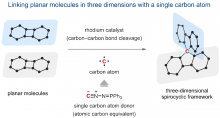
Researchers from the University of Osaka have developed a rhodium-catalyzed reaction that uses a single carbon atom to join two flat molecules into a rigid 3D spirocyclic structure. The reaction cleaves carbon–carbon single bonds and forms four new carbon–carbon bonds around one central carbon. It can join identical or different molecules, and it is expected to aid the design of new functional molecules for applications such as electronic materials.

09 Oct 2026
DNA breakdown in real time, How crystals bend without breaking, Mini-brain for Parkinson’s,
Heavy water helps weather forecasts, Exploring fish diversity and Mindfulness and self-stigma. Read it all in this month's Editor's Choice
21 Sep 2026
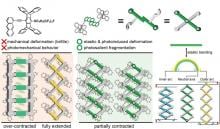
Chemists at National Taiwan University have uncovered a tiny scissor-like motion inside molecular crystals that helps explain why some crystals can bend and expand without breaking. By changing the molecular components that control how far these “scissors” can open and close, the team showed why closely related crystals can behave very differently—from brittle fracture to explosive motion and remarkable flexibility.
16 Sep 2026
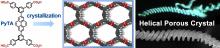
A research team led by the University of Osaka created porous crystals that grow into spring-like helices. The crystals expand and contract as solvent molecules leave and re-enter their pores. The work shows that crystallization conditions can tune the overall shape of a porous crystal without fundamentally changing its internal porous structure, opening possibilities for microscale materials that respond to chemicals.

10 Sep 2026
Many cutting-edge technologies rely on molecules that can be switched on and off with light, but making them respond efficiently to visible light without losing stability has long been a challenge. Researchers at Tohoku University, working with Heinrich Heine University Düsseldorf, solved this by attaching a "molecular antenna" that captures visible light and funnels the energy directly into the photoswitch, achieving some of the highest visible-light sensitivities ever reported.
07 Sep 2026
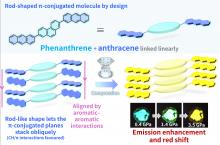
Researchers at the University of Osaka discovered a simple, rigid aromatic hydrocarbon that breaks the usual rule. Under pressure, its crystals grow 1.7 times brighter and shift color from light blue to yellow, with a record-high sensitivity of 37.4 nm/GPa, nearly double the previous best. An elongated, uniformly slender molecular shape was the key, offering a new design principle for pressure-responsive materials without complex flexible frameworks.
07 Aug 2026
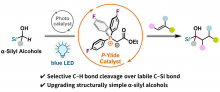
Kanazawa University, Japan – Research group led by Prof. Keiichi Hirano and Assistant Prof. Akira Matsumoto have developed a novel synthetic method for the selective cleavage of strong carbon–hydrogen (C–H) bonds while preserving weaker carbon–silicon (C–Si) bonds. This transformation enables the upgrading of structurally simple α-silyl alcohols into functionalized derivatives that are difficult to access by conventional methods. The key to this success lies in utilizing a finely tuned phosphonium ylide catalyst in combination with an organophotoredox catalyst under visible-light irradiation.
06 Aug 2026
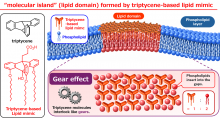
Researchers from the University of Osaka, Gunma University and Kyushu University created lipid mimic molecules that form “island”-like groups called lipid domains in artificial lipid membranes. The domains are thermally stable because the propellor-shaped moiety of the lipid mimic molecules interlock and the surrounding lipids fit into the spaces between. This new method of forming domains may allow artificial lipid membrane materials to be created for catalysis, capturing molecules, and drug delivery.
07 Jul 2026
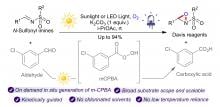
Researchers at the University of Osaka developed a light-driven method for synthesizing Davis reagents that generates the hazardous oxidant mCPBA only on demand and consumes it immediately. Kinetic analysis showed no detectable accumulation of the oxidant, improving process safety. The reaction proceeds at room temperature in non-halogenated solvents and can use sunlight or LEDs, offering a safer, greener, and scalable alternative for pharmaceutical-related synthesis.
02 Jul 2026
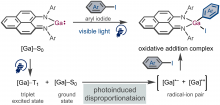
Oxidative addition is often carried out using transition metals and is challenging to perform at centers of more abundant main-group elements, particularly group 13 elements. Researchers at The University of Osaka, led by Takuya Kodama, achieved oxidative addition of an aryl iodide to a group 13 (gallium) center. The reaction is initiated by visible light. The reaction proceeds via a novel mechanism, photoinduced disproportionation, whereby photoexcited gallium exchanges electrons with ground-state gallium.
01 Jul 2026
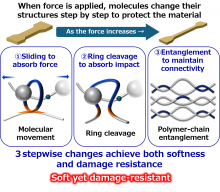
Researchers at the University of Osaka have synergistically combined three strategies for energy dissipation to enhance the toughness of elastomers. Rotaxane molecules with sacrificial bonds are incorporated into an elastomer. Under increasing external force, three mechanisms become sequentially activated: sliding of the rotaxane molecules, force-induced bond scission in the rings to form linear chains, and entanglement of the resulting chains. A polyurethane elastomer synthesized using this strategy was five times tougher than a conventional polyurethane.

21 Apr 2026
For many years, designing synthetic polymer systems has been inspired by the hierarchical self-assembly of folded proteins into functional nanostructures. However, extending folding-based design principles to small synthetic molecules has remained elusive. In particular, luminescent molecules with complex three-dimensional structures were considered difficult to assemble. Now, researchers from Japan demonstrate that such molecules can undergo folding-mediated self-assembly to form highly ordered nanotubes. These structures exhibit unique multidirectional energy transport, highlighting their potential for advanced optoelectronic applications.
03 Mar 2026
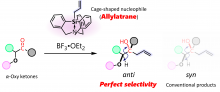
Diastereomers are molecules with identical structures that are not mirror images of each other, described as anti or syn for molecules without rings. Researchers at The University of Osaka developed a strategy for using a rigid cage-like molecule to produce an anti-diastereomer in high yield. This diastereomer can only be obtained as a minor byproduct by traditional methods. The strategy is expected to become a key technology for making medicines and other bioactive substances.
22 Oct 2025
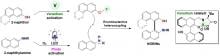
The University of Osaka researchers developed a world-first sustainable method for synthesizing pharmaceutical-grade NOBIN. By cooperatively utilizing a vanadium catalyst and energy-efficient LED light, the process eliminates byproducts, reduces waste, and allows for ideal raw material ratios, paving the way for greener and more efficient chiral molecule production.
14 Oct 2025
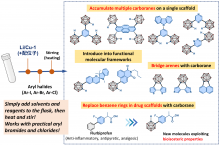
The University of Osaka scientists have developed a safe, efficient “dump-and-stir” method to introduce ortho-carborane into various aromatic compounds using a newly designed lithium–copper reagent. This innovation overcomes the complexity and hazards of previous methods, paving the way for new applications in boron neutron capture therapy (BNCT), three-dimensional aromatic materials, and bioisosteric drug design.
06 Oct 2025
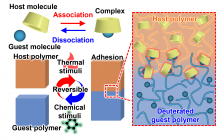
Researchers from The University of Osaka have developed a polymeric adhesion system by introducing reversible bonds at the adhesion interface based on the formation and dissociation of host–guest complexes. The adhesive can be decomposed on demand using temperature or chemicals and reused multiple times. Visualization of the interface using neutrons revealed the mechanism underlying repeatable sticking and peeling. This technology can be used for sustainable material applications.

27 Jun 2025
Researchers from the Institute of Industrial Science, The University of Tokyo, have developed nanoscale ‘molecular flasks’ based on single molecules of bottlebrush polymers to carefully control polymerization reactions in extremely small spaces

21 May 2025
Researchers at The University of Osaka have developed a non-precious metal catalyst for the efficient hydrogenation of biomass-derived furfural to valuable tetrahydrofuran-based compounds under mild conditions. The catalyst, consisting of nickel carbide nanoparticles supported on alumina, achieved 90% furfural conversion under ambient hydrogen pressure. This result will help advance the development of energy-efficient, cost-effective processes for the conversion of biomass to valuable materials.

21 Feb 2025
Mechanochemistry using a ball mill demonstrates versatility for generating academically and industrially significant organolithium compounds.

24 Jan 2025
A new theory predicts one of the effects of macroscopic mechanical forces on mechanochemical organic synthesis by a ball mill.

06 Dec 2024
Venice of the Pacific, Membrane transformers, Diverse meals, Nano dots and spirals & Extinct swimmers. Read all in the latest Editor's Choice.

15 Nov 2024
A new method streamlines the design and effectiveness of ligands used in chemical reactions in catalysis and drug delivery.

14 Nov 2024
Sometimes the holes, or pores, in the molecular structure of a chemical only appear in the presence of certain conditions or other ‘guest’ molecules. This affects the field of separation—one of the most important processes in industry—but researchers have only just begun to unravel this phenomenon

13 Nov 2024
Phase-transformable membrane featuring liquid-glass-crystal states achieves precise CO₂/H₂ selectivity and enhanced gas permeability through modular design with metal-organic polyhedra

10 Oct 2024
An organic catalyst offers chemists precise control over a vital step in activating hydrocarbons.

07 Oct 2024
Mirror, mirror, in my tank, who’s the biggest fish of all? Sigma bond spotted, Balancing cell membrane, Exploring quantum squeezing and Outbreak preparedness. Read all in the latest Editor's Choice.

25 Sep 2024
The discovery of a stable single-electron covalent bond between two carbon atoms validates a century-old theory.

02 Sep 2024
A re-analysis of early gas storage materials shows that they could adjust their shape to hold more gas, a property generally associated with newer, more advanced materials

11 Jun 2024
The selective bond-breaking powers of enzymes bring new versatility for building nanoparticles with a wide range of technical and medical potential.

28 Feb 2024
Molecules that are induced by light to rotate bulky groups around central bonds could be developed into photo-activated bioactive systems, molecular switches, and more.
Events
Sorry, nothing coming up for this discipline
Researchers

Dr. Yasser, Professor in Biochemistry, Dean of the Center for Research and Strategic Studies at Hajjah University, Yemen. HOD of Pharmacy Department. College of Medicine and Health Science, Hajjah University, Yemen. [email protected]. focuses on drug development, biochemical mechanisms of disease, and drug interactions, with a specific interest in the biological activity of compounds exhibiting anti-inflammatory, anticancer, antimicrobial, and anti-angiogenic properties. I utilize laboratory techniques, data analysis, and potentially clinical studies to advance understanding and improve drug efficacy and safety. My work involves student mentorship and collaboration

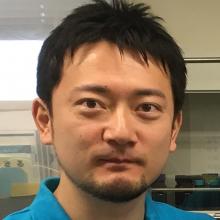
Associate Prof. Yusuke Ishigaki is a chemist at Hokkaido University, Japan. He works on the creation of fundamental chemistry based on original molecular design.

Dr. Omachi is Associate Professor, Research Center for Materials Science, Nagoya University
Giants in history

Osamu Shimomura (27 August 1928 – 19 October 2018) was a Japanese organic chemist and marine biologist who dedicated his career to understanding how organisms emitted light.

Indian organic chemist Asima Chatterjee (1917 to 2006) studied the medicinal properties of plant products, especially compounds known as vinca alkaloids.