
Gene regulation research mainly focuses on transcription factors. However, recent studies reveal core promoters as a critical yet overlooked component shaping the evolution and engineering of transcriptional regulation.
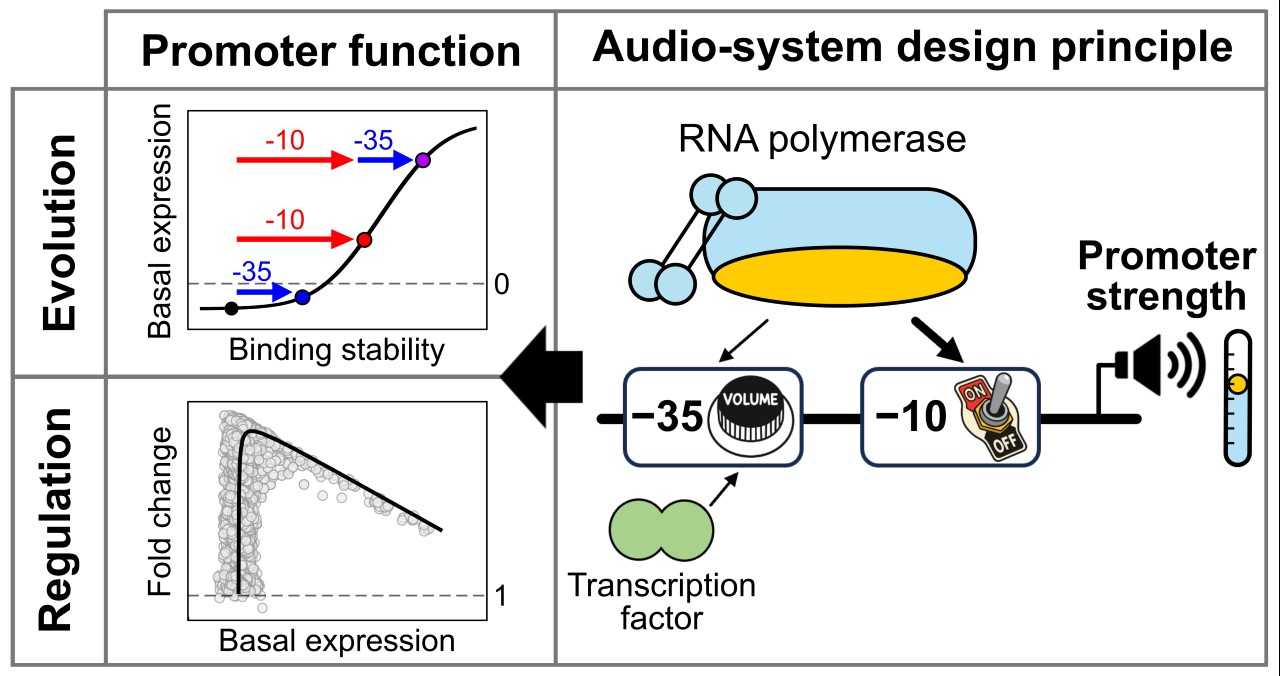
Bacterial promoters resemble an audio system. The –10 element acts as the ON/OFF switch, whereas the –35 element acts as the volume tuner. This design principle shapes transcriptional regulation and the evolution of promoters from random sequences.
Prof. Hsin-Hung David Chou
Bacterial promoters are DNA sequences that recruit RNA polymerase to initiate transcription, primarily through two elements called −10 and −35. However, the contributions of these elements to promoter evolution and regulation have remained unclear.
In a recent study published in Nature Communications, researchers at National Taiwan University (NTU) systematically characterized promoter libraries containing up to 16.8 million −10 and −35 sequence combinations in E. coli. Together with biophysical modeling and biochemical measurements, the team showed that the two elements play distinct roles, resembling the components in an audio system.
The −10 element acts as the ON/OFF switch: formation of an appropriate −10 sequence is essential for turning transcriptionally inactive DNA into a promoter. The −35 element instead behaves like a volume tuner, with sequence changes adjusting promoter strength. The study further showed that transcriptional activators act on this “volume tuner” to modify its interaction with RNA polymerase, directly linking core promoters to transcriptional regulation.
The large-scale promoter datasets also revealed a tradeoff between basal transcriptional activity and regulatory fold change: fold change reaches a maximum at intermediate basal expression, in contrast to the inverse relationship proposed in a recent Science study (DOI: 10.1126/science.adv2064). Follow-up work from the NTU team, posted on bioRxiv (DOI: 10.64898/2026.08.31.748186), confirmed this observation by analyzing additional empirical datasets and examining existing transcription-modeling frameworks.
The work also identified issues with data coverage and model formulation in the Science study that led to the apparent inverse relationship and the proposal of an unconventional repression mechanism—repressors inhibit transcription by overstabilizing rather than preventing RNA polymerase–promoter binding.
Together, the studies show that promoters are not passive docking sites for transcription factors. Instead, their core elements govern transcription initiation, tune expression levels, and set the dynamic range of gene regulation. This view also highlights core promoter sequence as a key design variable in synthetic biology. Another take-home message is the importance of broad data coverage to avoid “the blind men and the elephant” interpretation in systems biology.
“These findings uncover how random sequences evolve into promoters and establish a quantitative framework for predicting and engineering bacterial gene regulation,” says corresponding author Prof. Hsin-Hung David Chou of Department of Life Science at National Taiwan University.
Prof. Hsin-Hung David Chou’s email address: [email protected]
For further publications of Prof. Chou please visit:
Advertisement