
【Microstructure, CPO, and shear-wave anisotropy of shear-deformed δ-AlOOH】
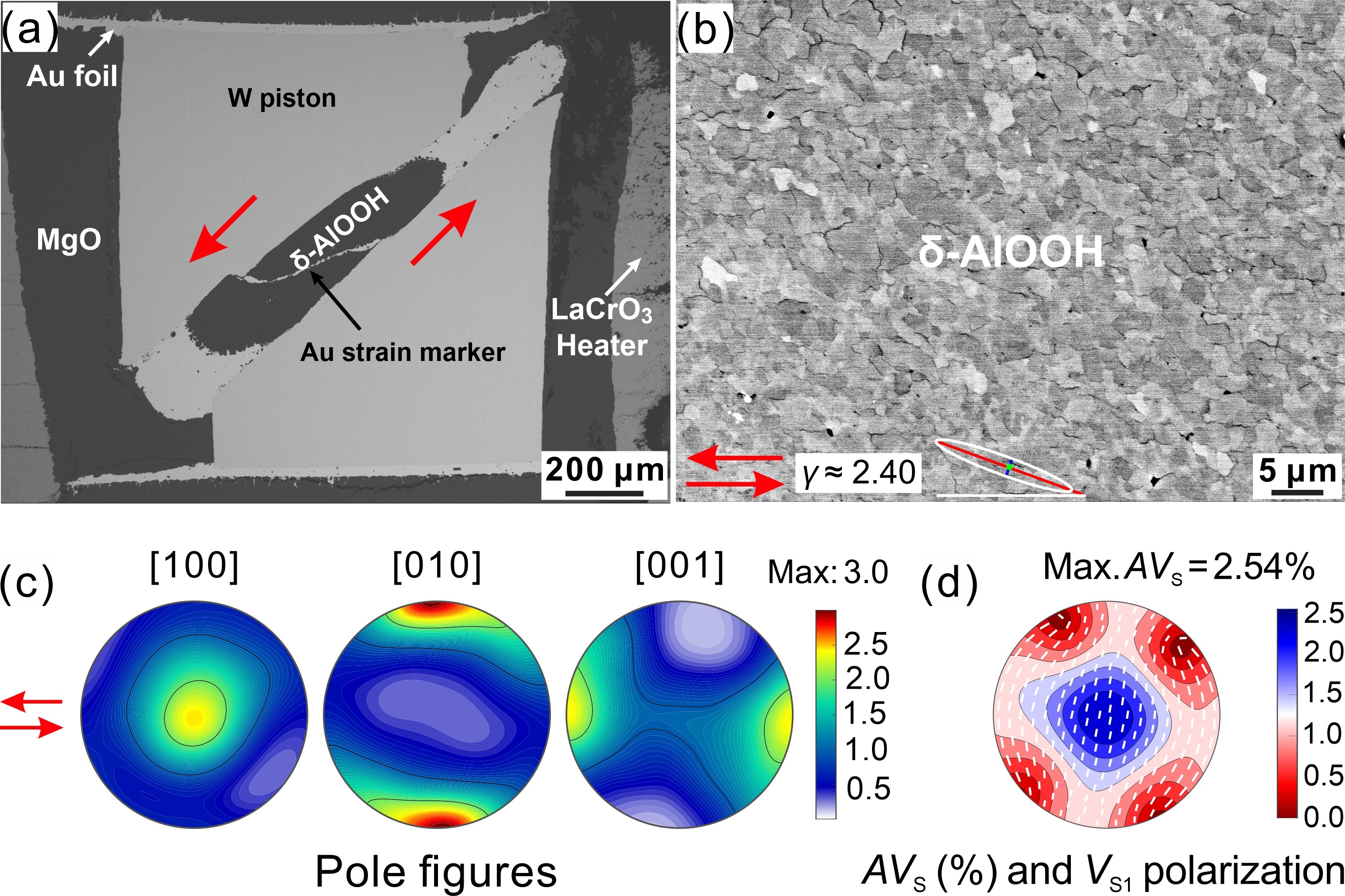
Images show the (a) shear deformation cell assembly and (b) microstructure of a shear-deformed δ-AlOOH aggregate deformed at 20 GPa and 950 °C, corresponding to lower mantle transition zone conditions. Large rotation of the strain marker indicates large shear strain in the sample. (c) CPO pole figures show that the (010) lattice plane preferentially aligns parallel to the shear plane after deformation, whereas [001] aligns subparallel to the shear direction. (d) Shear-wave anisotropy and polarization directions (white dashes) of the faster shear-wave velocity in the shear-deformed δ-AlOOH aggregate.
【Negative radial anisotropy near stagnant slabs explained by shear-deformed δ-AlOOH/δ-H.】
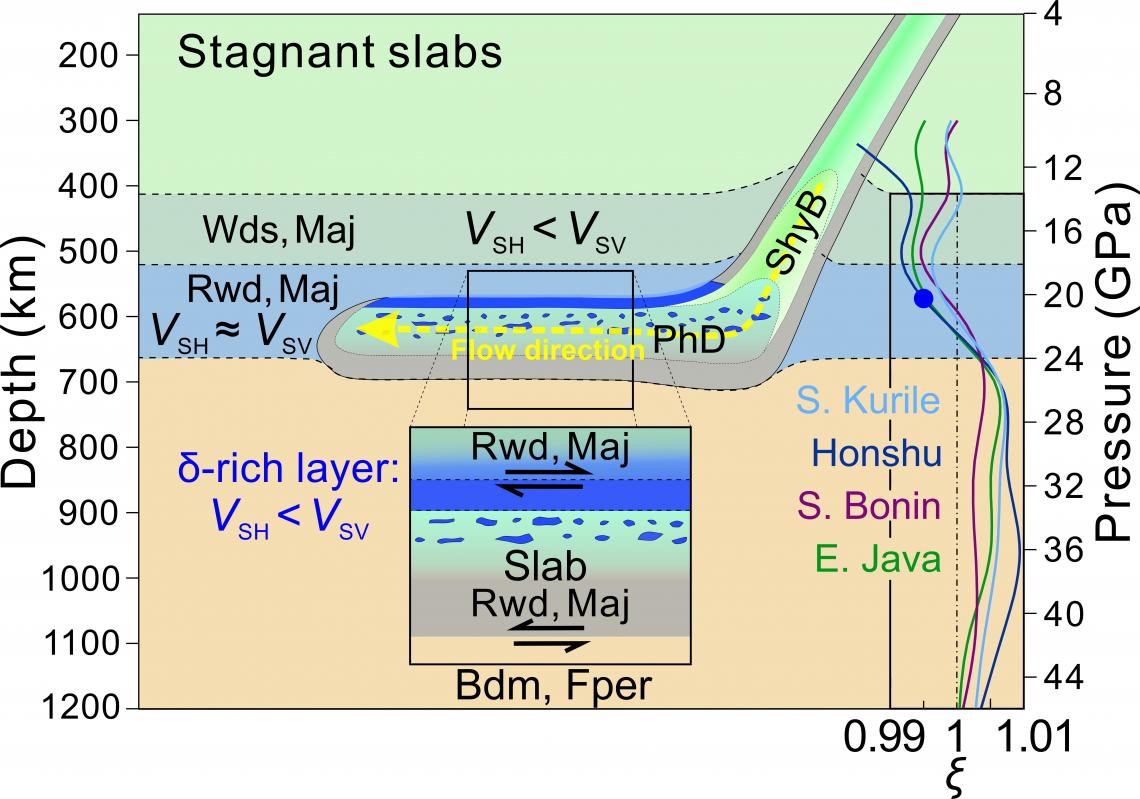
Schematic cross-sections of stagnant slabs with stability fields of selected hydrous phases in cold slabs. One-dimensional radial anisotropy profiles ξ = (V_SH/V_SV)^2 near representative slabs are modified after Ferreira et al. (2019). Blue dots indicate regions where ~15 vol.% δ-AlOOH/δ-H within isotropic mantle rocks is sufficient to explain the seismic anisotropy observed near stagnant slab tops in the lower mantle transition zone (ξ = 0.995). Abbreviations: Wds, wadsleyite; Rwd, ringwoodite; Maj, majorite; Bdm, bridgmanite; Fper, ferro‐periclase; ShyB, superhydrous phase B; PhD, phase D; δ, δ‐AlOOH.
Seismic waves traveling through the Earth’s interior often propagate at different speeds depending on their direction, a phenomenon known as seismic anisotropy. Such anisotropy is commonly detected beneath subduction zones, particularly near stagnant slabs in the mantle transition zone and uppermost lower mantle. However, the physical origin of these signals has remained uncertain.
In this study, we investigated the deformation behavior of special water-bearing minerals that can survive in cold, hydrated slabs at great depths. Using high-pressure and high-temperature experiments on two such minerals, δ-AlOOH and its solid solution with phase H (δ-H), which are stable under relatively cool slab conditions, we mimicked deformation in the deep Earth to better understand how these hydrous minerals deform inside subducting slabs in the mantle transition zone and uppermost lower mantle.
The results show that deformation causes these mineral aggregates to develop strong crystallographic preferred orientations (CPOs), producing a characteristic form of seismic anisotropy in which vertically polarized shear waves travel faster than horizontally polarized ones under horizontal flow. Combined with seismic observations, the results suggest that hydrous minerals may contribute significantly to the seismic anisotropy observed near flattened slab tops deep inside the Earth.