
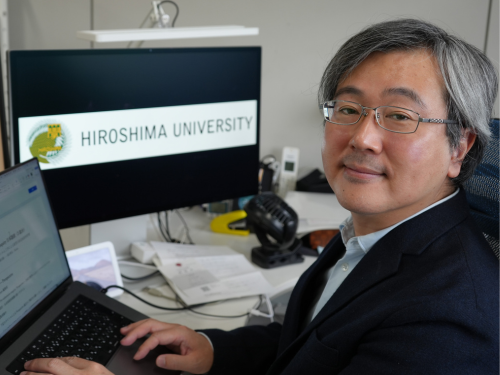
A Hiroshima University professor is one of the 14 scientists, and the sole awardee from Japan, selected for the 2026 Community Science Program (CSP) Large Scale Call of the US Department of Energy’s Joint Genome Institute (DOE-JGI).
Professor Fumito Maruyama of Hiroshima University’s The IDEC Institute secured support for a proposal to research Patescibacteria, a recently discovered phylum of ultrasmall bacteria measuring just 100 to 300 nanometers (a nanometer is one-billionth of a meter). These microorganisms carry reduced genomes, lacking many of the genes essential for life, and are thought to survive primarily through symbiotic or parasitic relationships with other microbes.
Despite their abundance in groundwater, the ecological roles of Patescibacteria and their interactions with other microorganisms remain largely unknown. Maruyama's team will use the US DOE-JGI’s advanced sequencing capabilities to reconstruct high-quality genomes of the bacteria and their host organisms, map metabolic pathways, clarify nutrient exchange and symbiotic interactions, and examine contributions to carbon, nitrogen, and other biogeochemical cycles. The findings are expected to yield new insights into previously unexplored microbial ecosystems in the deep subsurface, with potential implications for our understanding of global material cycles.
“Through this research, we aim to advance our understanding of the vast, unknown microbial world beneath our feet and open new frontiers in environmental microbiology,” Maruyama said.
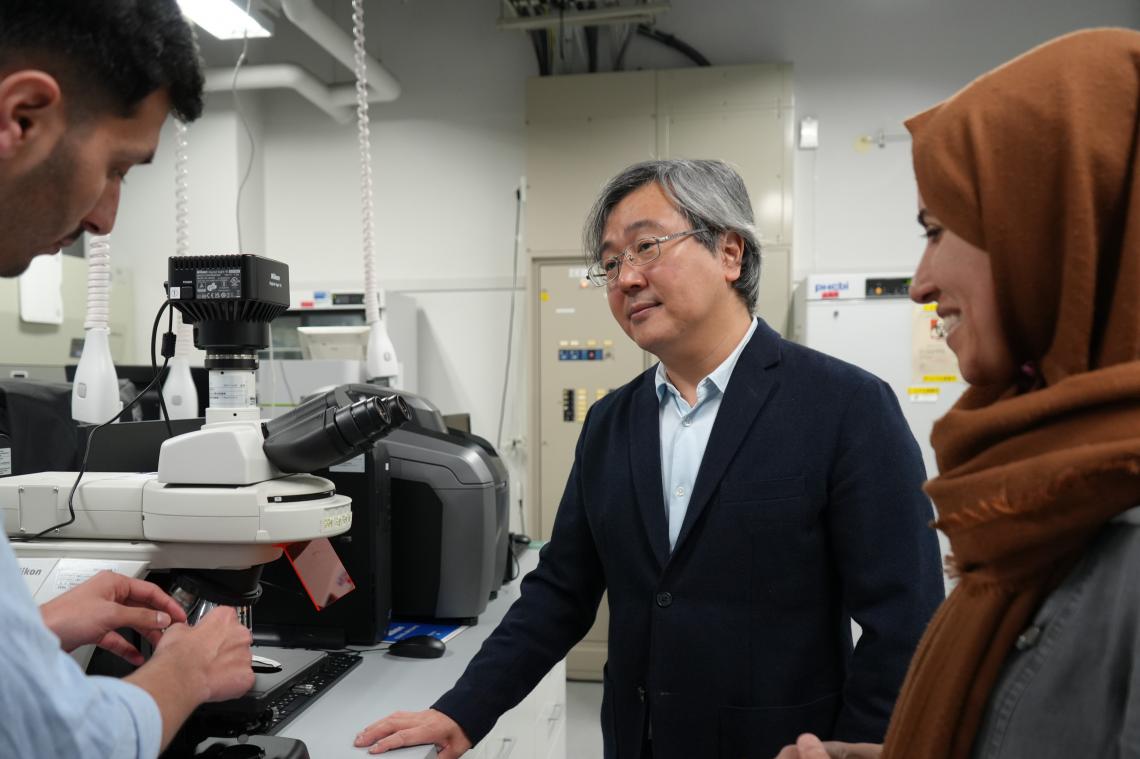
Professor Maruyama interacting with his graduate students
The CSP Large-Scale Call invites ambitious genome science proposals addressing global challenges aligned with the US DOE’s mission, including energy sustainability, climate change, and environmental resource conservation. Chosen projects gain access to sophisticated technologies—including genome analysis, high-throughput DNA sequencing, and computational resources—equivalent to hundreds of thousands to millions of US dollars provided free of charge by the US DOE-JGI.
Recognition in the CSP large-scale category is rare for researchers based in Japan, underscoring the international standing of Hiroshima University’s environmental genomics and microbiology research.
This distinction is expected to deepen the university’s partnerships with the US DOE-JGI and leading international collaborators, while opening doors for early-career researchers—including co-awardee Muneyuki Fukushi, a second-year doctoral student at Hiroshima University’s Graduate School of Innovation and Practice for Smart Society.
Other awardees include researchers from Princeton University, the University of Chicago, Duke University, and national research institutes in the US and France.
###
About Hiroshima University
Since its foundation in 1949, Hiroshima University has striven to become one of the most prominent and comprehensive universities in Japan for the promotion and development of scholarship and education. Consisting of 12 schools for undergraduate level and 5 graduate schools, ranging from natural sciences to humanities and social sciences, the university has grown into one of the most distinguished comprehensive research universities in Japan. English website: https://www.hiroshima-u.ac.jp/en