


Hiroshima University researchers have developed a practical framework to identify candidate pathogenic variants hidden among the large number of variants of uncertain significance (VUS) detected in comprehensive genomic profiling (CGP) of cancers. This framework could improve the accuracy of precision oncology by more reliable prioritization of VUS.
Overview of a framework for prioritizing variants of uncertain significance (VUS) identified by comprehensive genomic profiling (CGP), based on real-world data from 2,172 tests showing a higher prevalence of VUS than pathogenic variants in BRCA1/2. (Nakahara et al. European Journal of Human Genetics. March 3, 2026)
Nakahara et al. European Journal of Human Genetics. March 3, 2026
Comprehensive genomic profiling (CGP)enables comprehensive detection of genomic alterations across a wide range of cancer types and facilitates access to genome-matched therapies. However, it also poses a major challenge:a growing number of variants of uncertain significance (VUS)—genetic changes whose clinical impact remains unclear—which require careful interpretation and clinical management.In clinical genetics, the term variant is preferred over “mutation” to avoid implying pathogenicity.
A research team at Hiroshima University has proposed a framework to identify candidate VUS detected in CGP tests for further functional analysis. They developed and tested this framework usingBRCA1 and BRCA2 (BRCA1/2) as a model,genes in which germline pathogenic variants are known to cause Hereditary Breast and Ovarian Cancer (HBOC).
Their findings were published in the European Journal of Human Genetics on March 2, 2026.
Since CGP—a targeted sequencing approach that analyzes multiple cancer-related genes—was introduced into cancer care in Japan in 2019, more than 100,000 patients have undergone testing, integrating genomic data into clinical practice. This rapid implementation of CGP has accelerated precision oncology, where cancer care is tailored to individual genetics and molecular profiles.
“This study was motivated by a clinical observation,” says Hiroaki Niitsu M.D., Ph.D., specially appointed associate professor at Hiroshima University Hospital.“We encountered a patient who showed an exceptionally strong response to platinum-based chemotherapy. Despite postoperative recurrence in multiple organs and generally poor prognosis, he achieved surprisingly long-term remission.”
The research team collected data from patients who underwent CGP testing between Sept 2019 and July 2025 at 13 institutions in the Chugoku-Shikoku region of Japan. Of the 2172 CGP tests, 526 variants in BRCA1/2 were detected, including 130 known pathogenic variants and396 VUSrepresenting 153 unique variants. These 153 VUS were evaluated for pathogenicity using 10in silico predictors, validated computational methods that estimate the potential impact of genetic variants on protein function or RNA splicing using bioinformaticmodels.
“CGP frequently identifies variants of uncertain significance (VUS),” Niitsu explains. “In many cases, VUS outnumber clearly pathogenic variants, creating a practical challenge in clinical genomics: how to interpret and managethis growing uncertainty in routine care.”
The analysis prioritized 10 VUS selected for further functional investigation, including eight missense variants (a DNA change that alters a single amino acid in a protein) and two splicing variants (a genetic alteration that affects RNA splicing, potentially leading to abnormal proteins). Although all had been reported in laboratory studies, their clinical significancehad not been established.
“Our goal was to systemically prioritize variant that warrant further functional assessments.” Niitsu says.
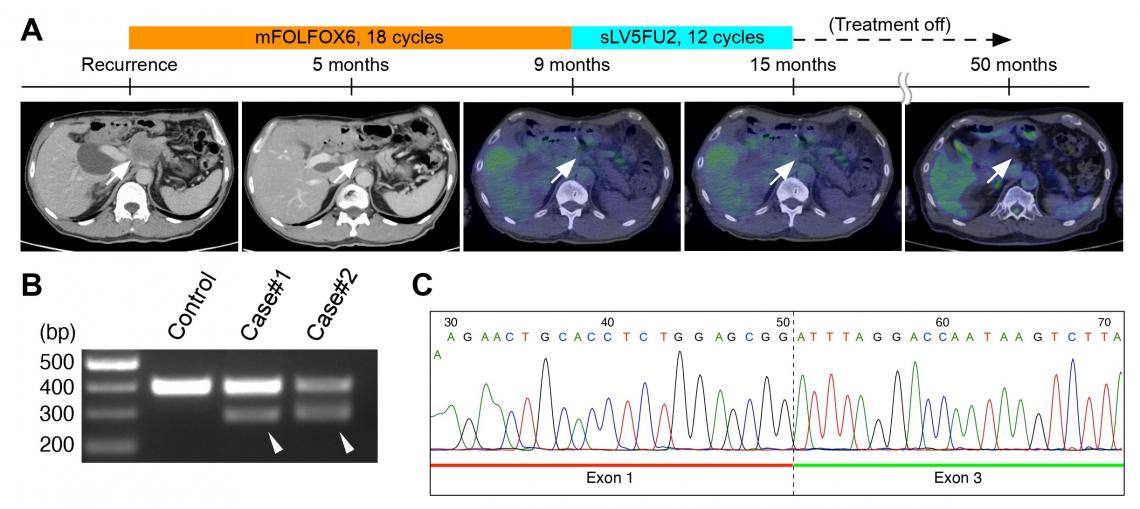
The researchers thenfocused on BRCA2:c.67G>C, a variant observed in multiple CGP tests and identifiedin the patient with the exceptionally strong response to platinum-based chemotherapy. Functional analysis revealed that this variant disrupts normal splicing of BRCA2, resulting in skipping of exon 2 and predicted disruption of the reading frame. This finding provides a potential explanation for the patient’s remarkable therapeutic response.
Together with a concurrent laboratory study, these findings support the classification of BRCA2:c.67 G>C as a pathogenic, heritable variant.
BRCA2:c.67G>C is associated with aberrant splicing and an exceptional response to platinum-based chemotherapy. (A) Clinical course and response to platinum-based chemotherapy in a patient with BRCA2:c.67G>C. (B–C) RT-PCR and Sanger sequencing demonstrate exon 2 skipping in BRCA2 mRNA amplicons corresponding to the exon-skipped transcript. (Nakahara et al. European Journal of Human Genetics. March 2, 2026)
Nakahara et al. European Journal of Human Genetics. March 2, 2026
“As a next step, we would like to examine whether this prioritization framework can be applied to variants identified in other hereditary cancer syndromes or inherited genetic disorders,” Niitsu concludes. “In addition, we aim to explore how the information from in silico prediction tools can be incorporated into the routine interpretation of comprehensive genomic profiling (CGP).”
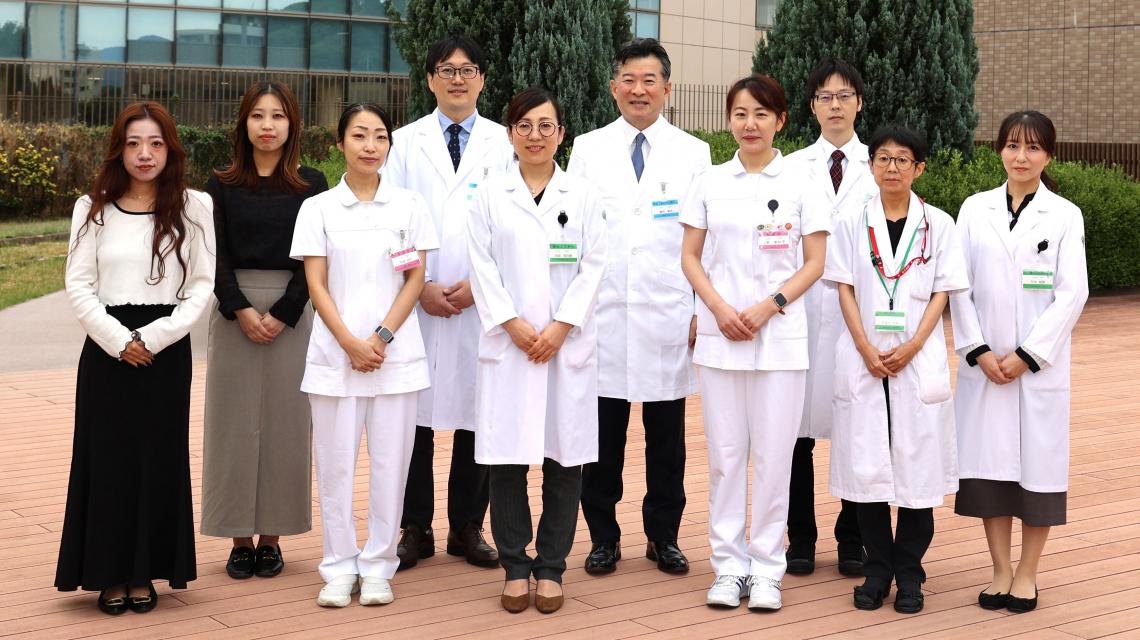
The research group at the Department of Clinical and Molecular Genetics, Hiroshima University Hospital. Hiroaki Niitsu (fourth from left), Takao Hinoi (fifth from right) and Hikaru Nakahara (third from right) were coauthors of the study. (Photo courtesy of Hiroaki Niitsu)
Photo courtesy of Hiroaki Niitsu
Hikaru Nakahara, Asuka Toshida, Khilola Madaminovna Saipova & Takao Hinoi at Hiroshima University Hospital; Nobuyuki Hinata & Keisuke Goto and C. Nelson Hayes & Shiro Oka at Hiroshima University; and Masami Yamauchi at Hiroshima Prefectural Hospital co-authored the study.
###
About Hiroshima University
Since its foundation in 1949, Hiroshima University has striven to become one of the most prominent and comprehensive universities in Japan for the promotion and development of scholarship and education. Consisting of 12 schools for undergraduate level and 5 graduate schools, ranging from natural sciences to humanities and social sciences, the university has grown into one of the most distinguished comprehensive research universities in Japan. English website: https://www.hiroshima-u.ac.jp/en
Advertisement