

Researchers at Kanazawa University report the blood-based gene expression tests may enable early pancreatic cancer screening and improve long-term survival.
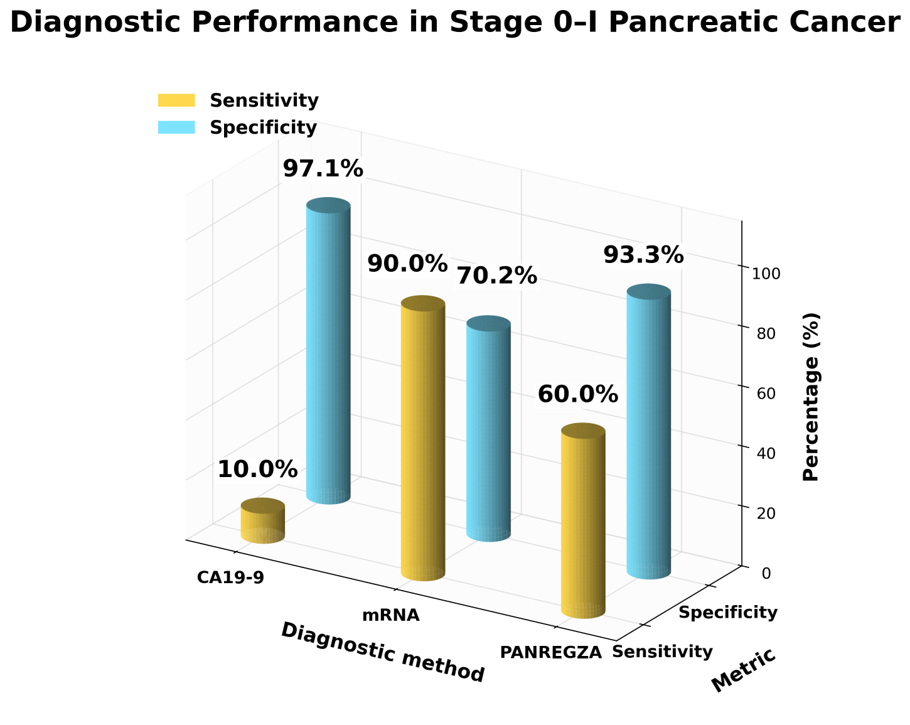
Figure1. Diagnostic performance in stage 0-Ⅰ pancreatic cancer
Diagnostic performance of peripheral whole blood gene expression patterns (mRNA), tumor marker CA19-9, and combined test (Panregza) for the diagnosis of stage 0–Ⅰ pancreatic cancer.
Kanazawa University
Pancreatic cancer is one of the most malignant cancers, with a five-year relative survival rate of only 8.5% in Japan (2009–2011, National Cancer Center data). Curative treatment is only possible when the disease is detected early and surgical resection can be performed. However, early-stage pancreatic cancer accounts for only 2–3% of all diagnosed cases due to the difficulty of early detection. This diagnostic challenge is a major factor contributing to the poor prognosis of pancreatic cancer. To improve outcomes, there is an urgent need for non-invasive diagnostic methods, particularly blood-based biomarkers, capable of efficiently detecting early-stage disease.
A research group led by Dr. Yamashita, Dean of the Graduate School of Advanced Preventive Medical Sciences and Professor of Gastroenterology at the Faculty of Medicine, Institute of Medical, Pharmaceutical and Health Sciences, Kanazawa University, has previously developed a pancreatic cancer diagnostic test called “Panregza”, which combines gene expression patterns from peripheral whole blood with the serum tumor marker CA19-9. While its effectiveness has been demonstrated primarily in advanced pancreatic cancer, its usefulness for detecting early-stage disease had not been clarified until now.
Yamashita and colleagues analyzed 10 patients with stage 0–Ⅰ pancreatic cancer (representing 4% of 253 cases) and compared them with 104 healthy individuals. The following diagnostic approaches were evaluated: 1) Peripheral whole blood gene expression patterns (mRNA), 2) Tumor marker CA19-9, 3) Combined test (Panregza).
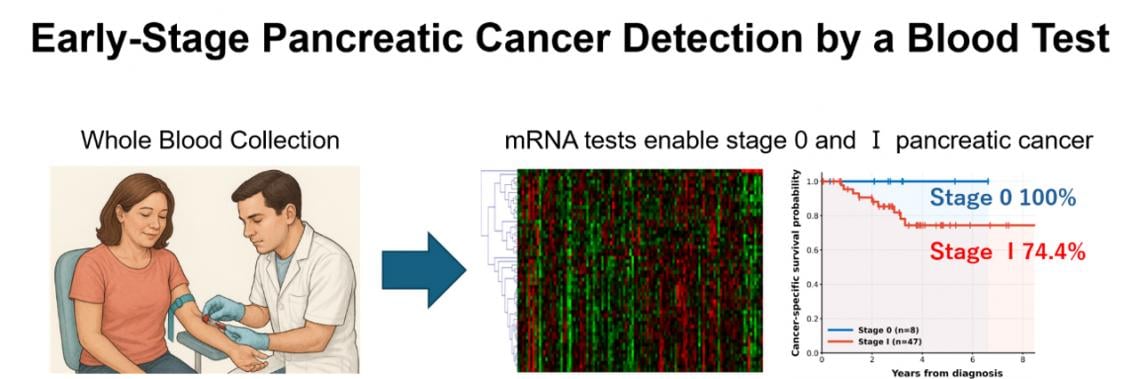
Using a panel of 56 gene probes, the gene expression approach successfully detected 9 out of 10 cases (90%) of early-stage pancreatic cancer (Figure 1). In contrast, CA19-9 detected only 1 out of 10 cases (10%), showing a substantial difference in detection performance. The combined Panregza test demonstrated 60% sensitivity and 93.3% specificity. These findings indicate that gene expression analysis from peripheral whole blood is a highly effective method for detecting early-stage pancreatic cancer. At Innovative Research and Development Center for Pancreatic Cancer, Kanazawa University Hospital, five-year survival rates are 100% for Stage 0 and 74.4% for Stage Ⅰ pancreatic cancer (Figure 2), emphasizing the critical role of early diagnosis in improving prognosis.
Background
Gene expression test in peripheral whole blood in pancreatic cancer
Researchers at Kanazawa University have previously found that gene expression patterns in peripheral blood mononuclear cells (PBMCs) differ between patients with pancreatic cancer and healthy individuals. Based on this finding, they developed a diagnostic kit called Panregza using whole blood and CA19-9, which is currently marketed by Cubix Inc.
Most PBMCs are immune cells, and it has been assumed that pancreatic cancer cells induce changes in gene expression by influencing these immune cells. However, it has remained unclear whether such expression changes also occur in early-stage pancreatic cancer, where the tumor burden is minimal.
This study demonstrated that even in stage 0–Ⅰ pancreatic cancer with normal CA19-9 levels, abnormalities in whole blood gene expression can be detected. These findings suggest that this diagnostic test enables early detection of pancreatic cancer and is not dependent on tumor volume.
Figure2. Early-stage pancreatic cancer detection by a blood test.
Toward the development of a diagnostic system for early-stage pancreatic cancer: A non-invasive, blood-based gene expression test enables the detection of Stage 0 pancreatic cancer (5-year survival rate: 100% at Kanazawa University Hospital) and StageⅠdisease (5-year survival rate: 74.4%).
Kanazawa University
###
Innovative Research and Development Center for Pancreatic Cancer at Kanazawa University Hospital
In response to the rising incidence of pancreatic cancer in recent years, this center was established in April 2025 with the aim of developing innovative diagnostic and therapeutic approaches. The center is led by Professor Shintaro Yagi of the Department of Hepato-Biliary-Pancreatic Surgery and Transplantation. Specialists from the Departments of Gastroenterology, Hepato-Biliary-Pancreatic Surgery and Transplantation, Radiology, Medical Oncology, and Pathology collaborate closely to advance the diagnosis, treatment, and research of pancreatic cancer.
About Kanazawa University
As the leading comprehensive university on the Sea of Japan coast, Kanazawa University has contributed greatly to higher education and academic research in Japan since it was founded in 1949. The University has three colleges and 17 schools offering courses in subjects that include medicine, computer engineering, and humanities.
The University is located on the coast of the Sea of Japan in Kanazawa – a city rich in history and culture. The city of Kanazawa has a highly respected intellectual profile since the time of the fiefdom (1598-1867). Kanazawa University is divided into two main campuses: Kakuma and Takaramachi for its approximately 10,200 students including 600 from overseas.
Advertisement