

Journal of the American Chemical Society
About Journal of the American Chemical Society
The flagship journal of the American Chemical Society, JACS publishes significant, highly cited articles with broad interest across all chemical science.
- Website: https://pubs.acs.org/journal/jacsat?
- Current Issue: https://pubs.acs.org/toc/jacsat/current
News

09 Sep 2025
Tohoku University
This promising new catalyst can speed up the oxygen evolution reaction to create clean energy.
20 Aug 2025
Tohoku University
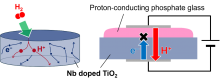
Most currently used fuel cells can only operate efficiently above 500°C, but researchers found a way to essentially cut that number in half.

22 Jul 2025
Tohoku University
Tohoku University researchers discovered some new principles that aid the electrochemical conversion of nitrate waste, an unwanted byproduct of modern day ammonia production. Their discovery will advance cleaner, more sustainable forms of ammonia production.
15 Jul 2025
YOKOHAMA National University
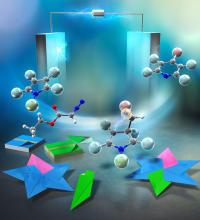
Method has organic chemistry applications, especially in pharmaceuticals.
14 Jul 2025
Tohoku University
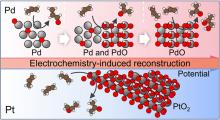
For many years, scientists have struggled to understand the mechanisms behind palladium/platinum catalysts for propylene electrooxidation, a sustainable means of producing valuable oxygen-containing organic compounds used in various industrial processes. Yet a research group has further clarified the matter in a recently published journal.

14 Jul 2025
National Taiwan University
Scientists introduced a second molecule to achieve a donor–acceptor (push–pull) effect, aiming to enhance both the efficiency and stability of perovskite and organic solar cells.

14 Jul 2025
Tohoku University
In a significant step towards a carbon-neutral future, researchers developed an atomically precise copper nanocluster that demonstrates high stability and exceptional selectivity in electrochemical carbon dioxide reduction reactions.

27 Jun 2025
Institute of Industrial Science, The University of Tokyo (UTokyo-IIS)
Researchers from the Institute of Industrial Science, The University of Tokyo, have developed nanoscale ‘molecular flasks’ based on single molecules of bottlebrush polymers to carefully control polymerization reactions in extremely small spaces

29 May 2025
Tohoku University
A team at Tohoku University has developed a data-driven method to accelerate the discovery of affordable, stable catalysts for clean hydrogen production. Using a digital platform called DigCat, they identified a low-cost metal oxide that performs both OER and HER in acidic conditions and remains stable over time.

23 Apr 2025
Tohoku University
Researchers have developed a mesoporous Co₃O₄ catalyst doped with atomically dispersed iridium (Ir) for efficient acidic OER. This unique structure boosts Ir efficiency, minimizes metal leaching, and maintains performance for over 100 hours at just 248 mV overpotential.

17 Apr 2025
National Taiwan University
Phosphorylation of tau protein triggers the formation of phase-separated liquid droplets of tau, known as liquid-liquid phase separation, in a temperature-dependent and reversible mechanism. The modified tau protein (p-tau) had a looser and more flexible shape, as shown by advanced protein analysis. Intracellular tau aggregation formed surrounding the cell nucleus only when cells were treated with this form of tau, similar to what is seen in Alzheimer’s disease brains.

14 Apr 2025
National Taiwan University
Real-time X-ray analysis reveals how single atoms dynamically adapt to boost CO2-to-CO conversion.

25 Mar 2025
The University of Osaka
Researchers from The University of Osaka report a new class of transition metal complexes with direct nickel-boron bonds without additional support.

19 Mar 2025
The University of Osaka
Cations found to be the culprit behind degraded platinum electrodes

12 Mar 2025
The University of Osaka
Scientists have achieved the first real-time visualization of how “excited-state aromaticity” emerges within just hundreds of femtoseconds and then triggers a molecule to change from bent to planar structure in a few picoseconds. By combining ultrafast electronic and vibrational spectroscopies, the team captured these fleeting structural changes at the molecular level and showed that aromaticity appears before—and then drives—the structural planarization. Their findings lay the groundwork for designing more efficient photoactive materials, such as sensors and light-driven molecular switches, by leveraging the power of aromaticity in excited states.

18 Feb 2025
Tohoku University
A new study has challenged conventional wisdom on oxygen reduction reaction (ORR) catalysts by uncovering a novel reaction pathway in weak-binding metal–nitrogen–carbon (M–N–C) single-atom catalysts (SACs), potentially revolutionizing the design of next-generation electrocatalysts for clean energy applications.

05 Dec 2024
Daegu Gyeongbuk Institute of Science and Technology (DGIST)
- DGIST Prof. Jongsung Yu and colleagues enhance platinum-cobalt alloy durability to boost green fuel cell performance and sustainability
- The study results published in the Journal of the American Chemical Society

27 Oct 2024
Tohoku University
Researchers at Tohoku University and the Tokyo University of Science are finding new ways to make the hydrogen evolution reaction harder, better, faster, and stronger!

07 Oct 2024
Tohoku University
Researchers at Tohoku University developed a novel method using facet-selective, ultrafine cocatalysts to efficiently split water to create hydrogen – a clean source of fuel.

21 Aug 2024
The University of Osaka
Researchers from Osaka University developed molecular wires with periodic twists. By controlling the lengths of regions between twists, the electrical conductivity of individual polymer chains can be enhanced. This work may lead to novel organic electronics or single-molecule wires.

04 Apr 2024
The University of Osaka
Researchers from Osaka University and Imperial College London have used operando optical spectroscopy in conjunction with other spectroscopic techniques to follow the oxygen evolution reaction (OER) for an iridium oxide catalyst. Using complementary techniques to probe the catalytic process at different pH values allowed them to observe the effect of the extended environment around the intermediate species involved. The findings are expected to contribute to optimizing the OER for green hydrogen production.
21 Feb 2024
Tohoku University
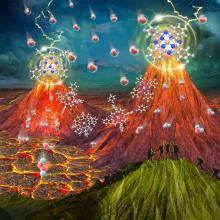
Metal-nitrogen-carbon (M-N-C) single-atom catalysts are a promising type of catalyst that could help provide cost-effective alternatives to platinum-based ones. However, there are still some aspects of their behavior that are misunderstood. To rectify this, a group of researchers delved into the intricacies of M-N-C catalysts, yielding promising results.
13 Feb 2024
The University of Osaka
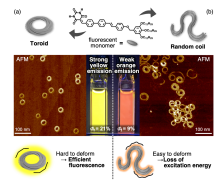
The properties of supramolecular polymers are dictated by the self-assembled state of the molecules. However, not much is known about the impact of morphologies on the properties of nano- and mesoscopic-scale polymeric assemblies. Recently, a research team demonstrated how terminus-free toroids and random coils derived from the same luminescent molecule show different photophysical properties. The team also presented a novel method for purifying the toroidal structure.

19 Jan 2024
Hokkaido University
Temperature-controlled, reversible shifting of molecular gear motion in a solid crystal opens new possibilities for material design.

25 Dec 2023
Hokkaido University
Researchers employ common plastics to kickstart radical chain reactions, creating a way to reuse plastic waste while improving process safety and efficiency.
20 Nov 2023
Ehime University
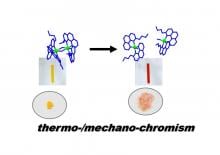
This paper highlights the underexplored potential of chiral self-sorting in the design of switchable and metastable discrete supramolecular structures.
14 Nov 2023
Osaka Metropolitan University
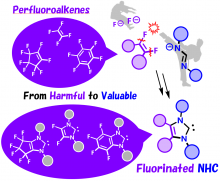
Osaka Metropolitan University researchers have successfully synthesized ligands called fluorinated N-heterocyclic carbenes (NHCs) from environmentally harmful perfluoroalkenes, a type of synthetic chemicals also referred to as PFAS. These NHCs are valuable for stabilizing unstable molecules and enhancing catalytic efficiency. Through further structural modification, these NHCs are expected to find applications in a wide range of substances, including catalysts and light-emitting materials.
21 Jun 2023
Osaka Metropolitan University
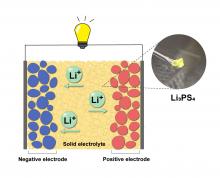
Osaka Metropolitan University researchers succeeded, for the first time, in stabilizing the high-temperature phase of Li3PS4—a solid electrolyte material¬¬—thus attaining high ionic conductivity even at room temperature, using a method of rapid heating during its crystallization. This unprecedented achievement is expected to contribute to the development of materials for all-solid-state batteries with higher performance.

10 Mar 2023
Hokkaido University
The first-ever molecular catalyst specifically tailored for mechanochemical reaction conditions enables high-efficiency transformations at near room temperature.

08 Feb 2023
Hokkaido University
Hokkaido University researchers have developed a novel method to design and develop peptide antibiotics in large numbers, which will prove critical to controlling antibiotic resistance.