
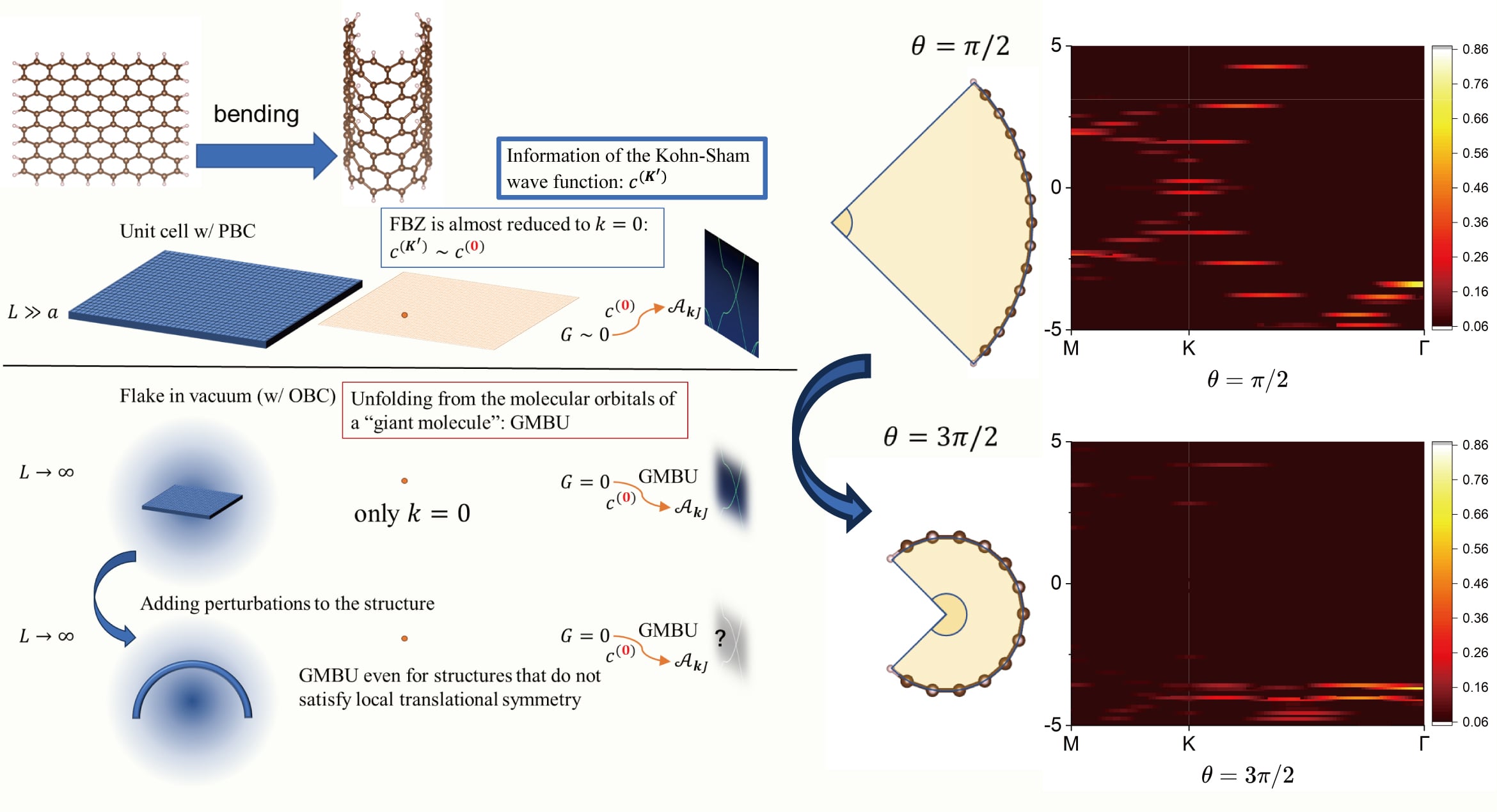

New “GMBU” procedure reveals band structures in finite, curved nanomaterials, linking nano‑ARPES and theory for next‑generation device design.
Giant molecule band unfolding visualizes band dispersions as local electronic structures in nanomaterials lacking translational symmetry, including bent nanoflakes, enabling interpretation of Dirac cones, spin–valley coupling, Rashba splitting, and their curvature effects, providing theoretical insight for nano-ARPES at nanoscale resolution.
2025 American Chemical Society. CC BY 4.0 (https://creativecommons.org/licenses/by/4.0/)
Kanazawa, Japan — An international collaborative research group, including Assistant Professor Naoya Yamaguchi and Professor Fumiyuki Ishii of Nanomaterials Research Institute, Kanazawa University, Associate Professor Chi-Cheng Lee of Tamkang University in Taiwan, and Professor Taisuke Ozaki of the University of Tokyo, has developed a new computational method to visualize the electronic states of aperiodic nanomaterials*1 as band*2 structures through first-principles calculations*3 on finite-sized giant molecule models. The approach reformulates band unfolding*4 for giant molecule models and works even when translational symmetry*5 is imperfect or the material is curved.
Nanomaterials possess unique electronic structures*6 and have attracted attention as materials with potential for new functionalities. While experimental observations have advanced with the development of electronic structure analysis techniques for nanomaterials, conventional first-principles calculations often struggle to analyze nanostructures lacking translational symmetry, and a sufficient theoretical analysis framework has not been established.
In this study, we extended the conventional band unfolding method, reformulated it to handle finite nanostructures, and implemented it as a computational program. We then positioned this series of procedures as the “Giant Molecule Band Unfolding (GMBU) procedure” and applied it to graphene, transition metal dichalcogenides (tungsten disulfide (WS₂)), and bismuth/silver surface alloy nanoflakes. As a result, we successfully visualized clear electronic band structures even in finite models at the nanometer scale. Furthermore, we confirmed its applicability to curved structures and demonstrated its usefulness as a universal analytical framework for electronic structure analysis of nanomaterials.
The GMBU procedure is a flexible computational technique that enables analysis of electronic structures from a band theory perspective by integrating with large-scale first-principles calculations, even when translational symmetry is not fully established or when spatial inhomogeneities and fluctuations exist within the material, provided the material exhibits local periodicity. It is expected to see extensive future applications.
The results of this research are expected to promote collaboration between experimental observations using increasingly high-resolution nano-ARPES and theoretical analysis, contributing to the advancement of next-generation electronics and spintronics material design.
This research will be published online in the U.S. scientific journal Nano Letters on December 10, 2025, at 8:00 AM (Eastern Standard Time). It has also been selected for the journal's cover (Supplementary Cover).
【Glossary】
*1: Nanomaterials
Materials possessing characteristic structures (nanostructures) at the nanoscale. They are often artificially fabricated using microfabrication techniques. Controlling nanomaterials requires not only sample fabrication techniques but also the development of measurement technologies.
*2: Band
In solids, the energy distribution of electron orbitals forms bands. Each of these band-like distributions is referred to as a band.
*3: First-principles calculation
A computational scientific method that calculates electronic structures based on the fundamental equations of quantum mechanics, without relying on experimental observation. Band structures can be obtained using first-principles calculations performed on computers.
*4: Band unfolding
A method for unfolding the band structure of a calculation model with an enlarged period. This allows for a more intuitive comparison between the band structure of the computational model with the original period and the ARPES measurement results.
*5: Translational symmetry
The property whereby a system remains unchanged when translated parallel to itself by a certain distance. In an ideal solid crystal, translational symmetry is satisfied, and the same crystal lattice appears repeatedly in adjacent areas.
*6: Electronic structure
The behavior of electrons inside a material. Many material properties are determined by the electronic structure.
Advertisement
Advertisement