
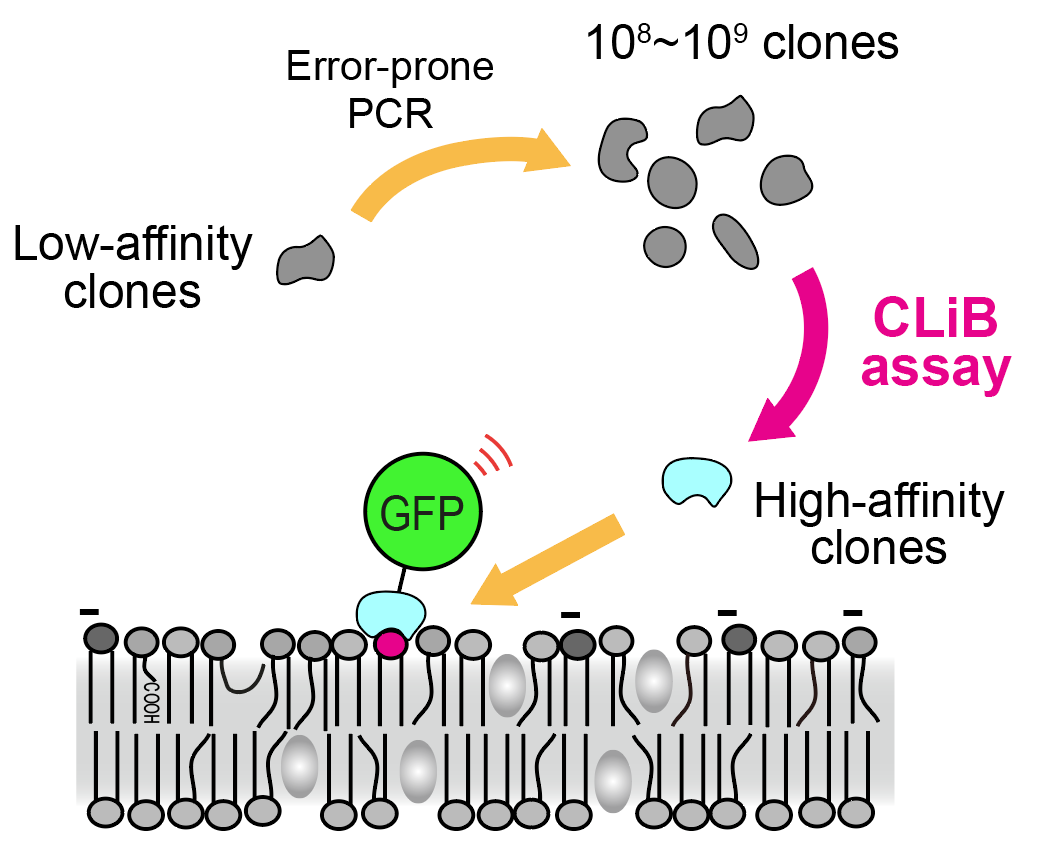

Researchers at the University of Osaka developed the CLiB assay, a high-throughput platform to engineer protein-based lipid-binding probes. By screening a library of protein variants, they created a highly sensitive probe for the signaling lipid PI(3,5)P2. This tool allowed the team to visualize how cells remodel their membranes to engulf damaged materials, providing a framework for developing next-generation biosensors and unlocking new insights into the dynamic landscape of biological membranes.
Fig. 1
The CLiB assay enables the engineering of lipid-binding probes.
Original content, Credit must be given to the creator. Adaptations must be shared under the same terms. Only noncommercial uses of the work are permitted., Taki Nishimura
Researchers from the University of Osaka develop a high-throughput platform to engineer versatile biosensors that track elusive signaling lipids and may speed up cell biology research and drug discovery
Osaka, Japan – Inside every cell are lipid molecules that make up cellular membranes, helping organelles communicate and respond to stress. Researchers have struggled to observe lipids in action because current detection tools lack sufficient sensitivity and selectivity, hindering advances in the understanding of lipids.
Now, a team led by researchers at the University of Osaka has developed a method to “evolve” custom biological sensors, making them capable of tracking these molecules in living cells. In a study published this month in Nature Cell Biology, the multidisciplinary team introduced the Cell surface Liposome Binding (CLiB) assay, a high-throughput method that uses yeast cells, liposomes – microscopic capsules made of lipids – and fluorescence readouts to test how thousands of protein variants bind to lipids.
“Until now, researchers have lacked a systematic way to develop specific lipid biosensors, which has been a major bottleneck in studying the roles of lipids in biology and disease,” says lead author Taki Nishimura. “But this new high-throughput technology, the CLiB assay, lets us test a huge number of proteins at once and quickly find the best matches.”
Using the CLiB assay, the team screened a library of protein variants and refined an existing sensor through an evolution-like process, creating a new probe called PX-SnxAGV. This probe can detect the rare signaling lipid PI(3,5)P2, which has been notoriously difficult to track because it typically exists in tiny amounts.
In living cells, this probe revealed a surprising pattern: under stress conditions, such as sudden increases in salt, PI(3,5)P2 accumulates in small, distinct regions of the membrane. Similarly, in mammalian cells undergoing microautophagy – a “self-eating” clean-up process where lysosomes, the cell’s recycling centers, directly engulf and break down damaged components – PI(3,5)P2 is enriched at sites where the membrane begins to fold inward to engulf its cargo.
Beyond these findings, the new CLiB method may have broad applications. Many diseases involve problems with cell membranes, so a better understanding of lipids could open new paths for treatment.
“With these probes, we can now see when and where lipids appear inside cells,” explains Nishimura. “These advances will deepen our understanding of membrane lipid environments and how they influence a wide range of diseases, such as cancer, diabetes, and neurodegenerative diseases.”
By detecting previously invisible molecules, the CLiB assay provides a new way to study the inner workings of cells, potentially accelerating discoveries across cell biology, medical research, and AI-driven drug development.
###
The article, “Cell surface Liposome Binding (CLiB) allows lipid-binding probe engineering via high-throughput screening,” will be published in Nature Cell Biology at DOI: https://doi.org/10.1038/s41556-026-01996-8
About The University of Osaka
The University of Osaka was founded in 1931 as one of the seven imperial universities of Japan and is now one of Japan's leading comprehensive universities with a broad disciplinary spectrum. This strength is coupled with a singular drive for innovation that extends throughout the scientific process, from fundamental research to the creation of applied technology with positive economic impacts. Its commitment to innovation has been recognized in Japan and around the world. Now, The University of Osaka is leveraging its role as a Designated National University Corporation selected by the Ministry of Education, Culture, Sports, Science and Technology to contribute to innovation for human welfare, sustainable development of society, and social transformation.
Website: https://resou.osaka-u.ac.jp/en
Advertisement