

A research group has developed “TP-An,” a molecule that enables even low-energy, long-wavelength light to be used more effectively by solar cells and photocatalysts. The molecule can be used even at high concentrations that are difficult for traditional materials, suggesting their usefulness in technology.
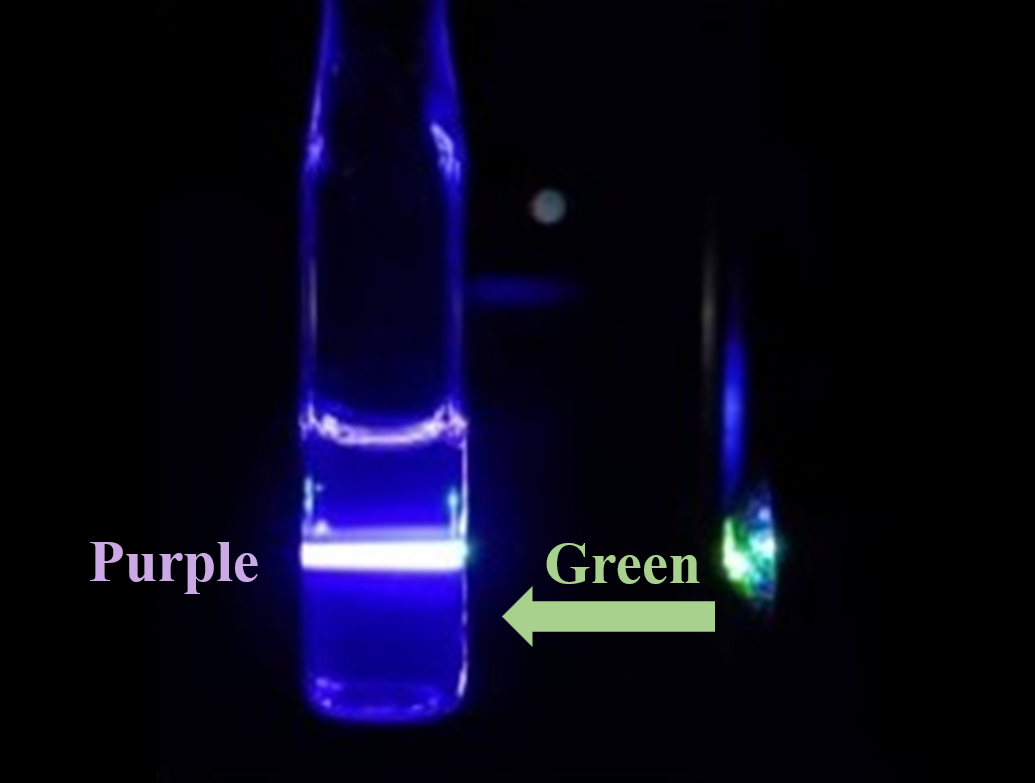
Green light is converted into brighter purple light using the newly synthesized molecule: A laser at 533 nm, the wavelength of green light, is emitted into a vial containing TP-An, causing 413 nm purple light to be emitted. This conversion of light into lower wavelength light creates a bright light.
Osaka Metropolitan University
Solar cells and photocatalysts can be surprisingly inefficient.
Despite light consisting of many wavelengths, the range that even highly efficient devices use is limited. Other wavelengths, especially long wavelengths, simply pass through the material without being utilized as energy.
To improve the efficiency of solar energy utilization, a technique called photon upconversion (PUC) is attracting attention. In particular, triplet–triplet annihilation-based PUC (TTA-PUC) converts long-wavelength, low-energy light into shorter wavelengths that can be more readily absorbed by solar cells.
Now, a research group led by Osaka Metropolitan University has developed a new triplet-energy acceptor molecule, “TP-An,” that enables highly efficient TTA-PUC even under weak excitation conditions.
“Currently, 9,10-diphenylanthracene is the most widely used acceptor molecule, and research is focused on the design and optimization of its derivatives. Although it performs well in dilute solutions, it tends to lose its efficiency as concentration increases. This has hindered its practical use as most solar energy-harvesting devices require relatively high concentrations of active molecules,” Professor Hiroshi Ikeda of the Graduate School of Engineering explained. “On the other hand, TP-An maintains an exceptionally high quantum yield even at high concentrations.”
The researchers synthesized TP-An because they wanted to synthesize an “ideal acceptor” molecule for TTA-PUC. The resultant molecule exceeded their expectations, as they achieved a fluorescence quantum yield exceeding 99%; meaning that for every 100 photons, 99 are emitted in a usable form and only one is lost through heat, molecular vibrations, or chemical reactions.
When they shone green light on the solution, it emitted purple light. This showed that upconversion was occurring, as purple light has more energy and a lower wavelength than green light.
Further tests showed an upconversion quantum yield was about 23%, meaning that nearly one-quarter of the maximum possible upconverted light output was achieved.
“This is an exceptionally high value for this type of system,” Tomoki Nagaoka, a graduate student and the first author of the study, said. “This is close to the highest upconversion quantum yield reported to date. The fact that TP-An achieves a nearly comparable upconversion performance and works well even at high concentrations demonstrates the potential of this material.”
In the future, the group aims to develop PUC materials capable of converting a wide range of light wavelengths, as well as materials that can achieve highly efficient PUC even in the solid state.
“In the future, we expect applications across a broad range of fields, including photocatalysis, photochemical reactions, and solar energy utilization technologies,” Associate Professor Yasunori Matsui said.
The findings were published in Journal of the Physical Chemistry Letters.
Competing Interests
The authors declare no competing financial interest.
###
About OMU
Established in Osaka as one of the largest public universities in Japan, Osaka Metropolitan University is committed to shaping the future of society through the “Convergence of Knowledge” and the promotion of world-class research. For more research news, visit https://www.omu.ac.jp/en/ and follow us on social media: X, Instagram, LinkedIn.
Advertisement
Advertisement