

Researchers led by the University of Osaka developed a reusable light-responsive adhesive that switches adhesion at the interface instead of weakening the whole material. UV-A light reduces interfacial adhesion, enabling selective peeling without observable residue, while UV-C light restores adhesion. The response was retained through repeated cycles without solvent processing. The approach could simplify disassembly, repair, and recycling of electronics, vehicles, and semiconductor components, supporting more circular manufacturing across industries.
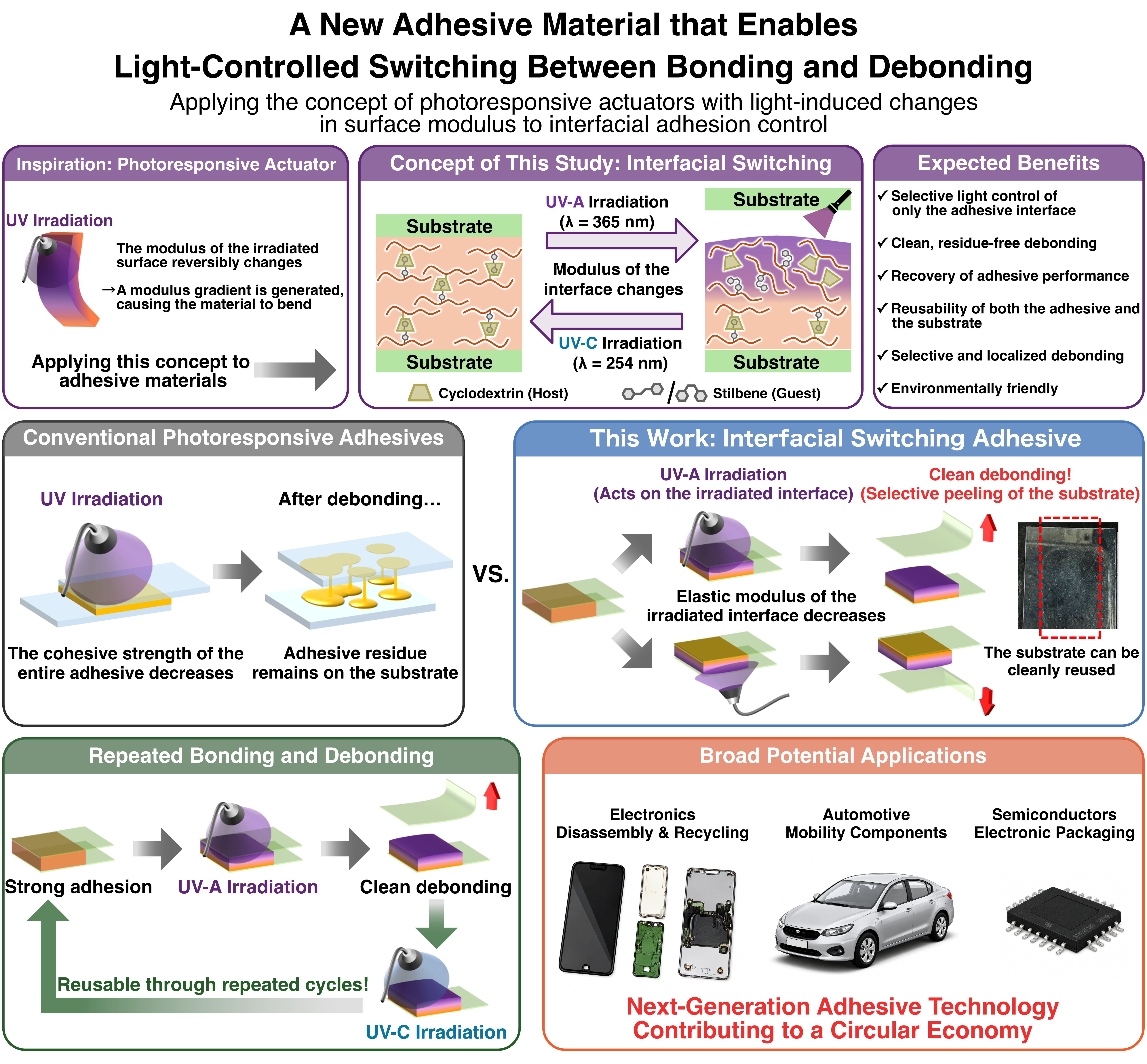
Fig. 1
Concept and key features of the photoresponsive adhesive developed in this study. Based on the concept of “interfacial switching,” light irradiation selectively changes the elastic modulus of only the adhesive interface, enabling clean, residue-free debonding while allowing both the substrate and the adhesive to be reused. The technology is expected to contribute to the recycling of electronic devices, automobiles, semiconductor components, and other products.
Original content, Credit must be given to the creator., Yoshinori Takashima
A reusable light-responsive adhesive uses light to switch only its interface, enabling selective peeling without observable residue and recovery of adhesion.
Osaka, Japan - Adhesives are essential in electronics, vehicles, and other products, but they can hinder repair and recycling when bonded parts are difficult to separate cleanly. A research team led by The University of Osaka has developed a prototype light-responsive adhesive that can be selectively detached from an illuminated surface without observable residue. The adhesive film can then be rebonded by heating and reused after a second ultraviolet wavelength helps reset its molecular interactions. This study will be published in Matter & Light.
Conventional photoresponsive adhesives release a bond by weakening or chemically changing the adhesive layer itself. That approach can leave residue on a substrate. Other systems achieve cleaner separation through irreversible light-driven reactions, but the adhesive is then difficult to reuse. The team instead aimed to control only the adhesive-substrate interface while keeping the bulk adhesive intact.
The researchers designed a polymer adhesive with reversible host-guest crosslinks between stilbene and triacetylated beta-cyclodextrin. Inspired by photoresponsive actuators, light-driven changes in these crosslinks alter local surface mechanics, creating “interfacial switching”.
Under UV-A light (365 nm), stilbene photoisomerization weakens host-guest association near the illuminated surface. In the optimized material, peel strength fell by about 45%, allowing selective peeling without observable adhesive residue. Similar switching was demonstrated with PET paired with glass, carbon-fiber-reinforced plastic, Nylon 66, and aluminum.
UV-C light (254 nm) restored host-guest association and adhesion. The light-controlled response was retained through 15 peeling cycles; samples were rebonded by heating without solvent processing. Atomic force microscopy confirmed reversible changes in surface stiffness and adhesion.
By switching adhesion at the interface instead of damaging the adhesive bulk, this strategy could ease disassembly, repair, and recycling of electronic, automotive, and semiconductor components. It also offers a design principle for dynamic polymer interfaces and circular manufacturing.
“We asked whether changing only the stiffness at an adhesive interface with light could allow clean peeling without destroying the adhesive itself,” says senior author Professor Yoshinori Takashima. “We hope this concept will lead to advanced adhesives and support more circular manufacturing.”
###
The article, “Interfacial Switching-Driven Photoactuator Adhesives for Selective Peeling and Substrate Recycling,” will be published in Matter & Light at DOI: https://doi.org/10.1016/j.matlit.2026.100094
About The University of Osaka
The University of Osaka was founded in 1931 as one of the seven imperial universities of Japan and is now one of Japan's leading comprehensive universities with a broad disciplinary spectrum. This strength is coupled with a singular drive for innovation that extends throughout the scientific process, from fundamental research to the creation of applied technology with positive economic impacts. Its commitment to innovation has been recognized in Japan and around the world. Now, The University of Osaka is leveraging its role as a Designated National University Corporation selected by the Ministry of Education, Culture, Sports, Science and Technology to contribute to innovation for human welfare, sustainable development of society, and social transformation.
Website: https://resou.osaka-u.ac.jp/en
Advertisement
Advertisement