


KRAS G12C inhibitors provide an important treatment option for patients with KRAS G12C-mutant lung cancer, but some tumors respond poorly from the outset. Alterations in KEAP1, a gene involved in cellular stress responses, are associated with reduced sensitivity to these drugs.
Some KRAS G12C-mutant lung cancers are resistant to KRAS G12C inhibitors from the outset. Loss of KEAP1 increases expression of pyruvate carboxylase (PC), allowing cancer cells to maintain metabolites required for growth during treatment. Genetic deletion of PC restored sensitivity to sotorasib and enhanced tumor suppression in mouse models.
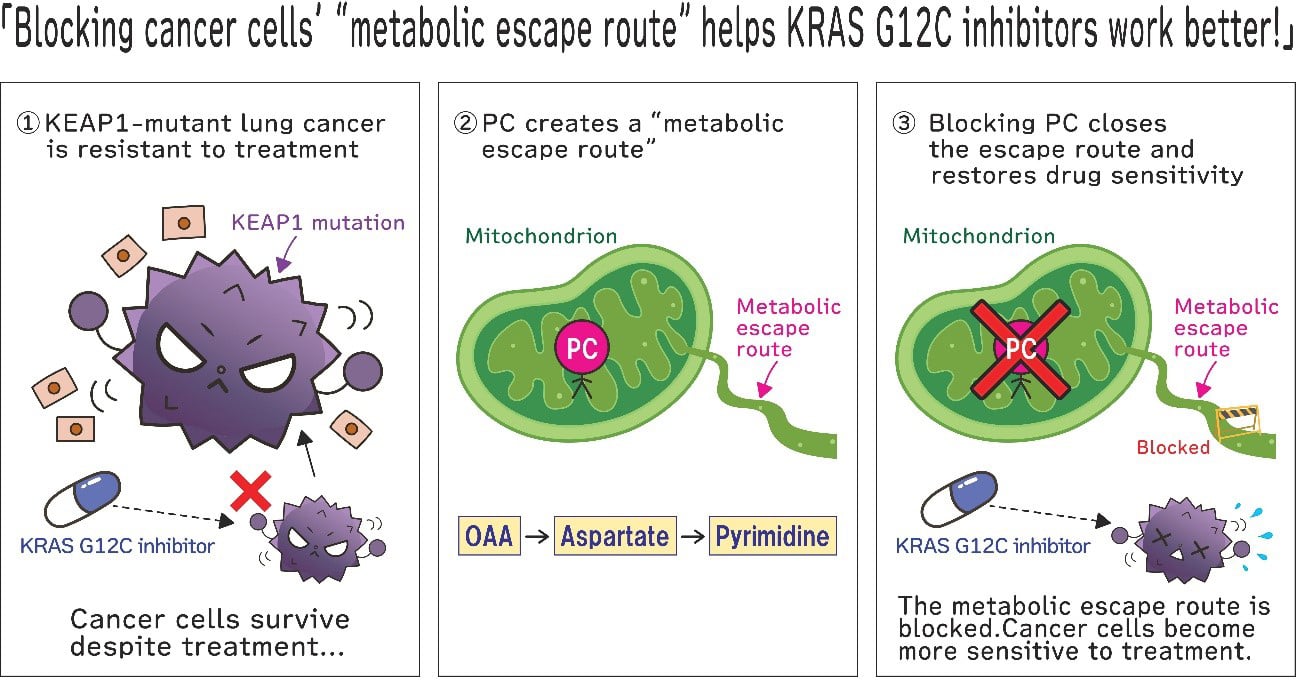
Figure. KEAP1-deficient lung cancer cells use PC-dependent metabolism as a metabolic escape route during KRAS G12C inhibition. Blocking PC restores sensitivity to treatment.
Illustration: Prr
How KEAP1 loss rewires cancer metabolism
KRAS G12C inhibitors directly block mutant KRAS, but additional genetic alterations can strongly influence treatment response. KEAP1 loss activates NRF2, a transcription factor that regulates cellular stress responses and metabolism.
In genetically defined lung cancer models, KEAP1 loss increased PC expression and enhanced the conversion of glucose-derived pyruvate into oxaloacetate. This pathway supplied oxaloacetate and aspartate and maintained the production of pyrimidine nucleotides, essential building blocks of DNA and RNA. KEAP1-deficient cells therefore retained a source of metabolites required for growth even during KRAS G12C inhibition.
Blocking the metabolic escape route
Deletion of PC reduced the growth of KEAP1-deficient lung cancer cells and restored their sensitivity to sotorasib. A cell-permeable form of oxaloacetate rescued the growth of PC-deficient cells. In mouse tumor models, PC loss enhanced the antitumor effect of sotorasib.
These results show that KEAP1-deficient lung cancer cells use PC-dependent metabolism to sustain growth during KRAS G12C inhibition.
A potential strategy for treatment-resistant lung cancer
Resistance to KRAS-targeted therapy is often attributed to changes in signaling pathways. Metabolic adaptation can also support resistance. PC-dependent production of oxaloacetate, aspartate and pyrimidine nucleotides represents a metabolic vulnerability in KEAP1-deficient lung cancer. Targeting this pathway may provide a way to improve responses to KRAS G12C inhibitors in tumors that are otherwise difficult to treat.
Further studies will be needed to develop effective PC inhibitors and evaluate their efficacy in combination with KRAS G12C-targeted therapy in KEAP1-deficient lung cancer.
Advertisement