
This story is featured in the Asia Research News 2026 magazine. Book space in the next issue now.
Get the news in your inbox
Extracellular vesicles (EVs) are microscopic particles released by cells that help them communicate, repair damage, and carry molecular messages. Because of these functions, EVs are being studied as potential tools for diagnosing and treating various diseases. However, collecting EVs is often slow, expensive, and technically demanding. Traditional methods, like ultra-centrifugation, can take many hours, require specialised equipment, and sometimes damage the EVs.
Researchers from the National Taiwan University of Science and Technology (Taiwan Tech) and Taipei Medical University have developed a compact, easy-to-use device that isolates EVs in under two hours. The device, called the EV-Osmoprocessor (EVOs), was described in a study published in the journal Science and Technology of Advanced Materials.
“Until now, isolating these particles has been slow and complicated,” says James Lai of the Department of Material Science and Engineering at Taiwan Tech, the study’s lead author. “EVOs offer a faster, simpler approach that maintains vesicle quality and increases accessibility.”
The device uses osmosis to filter out background molecules such as proteins and excess water while retaining EVs. An aqueous polymer solution draws water through a membrane, concentrating the EVs without the need for spinning or pressure. The process is completed without electricity and requires minimal training.
In tests using stem cell culture fluid, EVOs reduced sample volume by 50 times and removed over 99% of albumin, a protein that can interfere with EV analysis. The isolated EVs remained about 140 nanometres in size and showed strong biological activity in lab models.
When tested in a simulated heart injury environment, the EVs helped protect human heart cells from oxygen deprivation, confirming their healing potential.
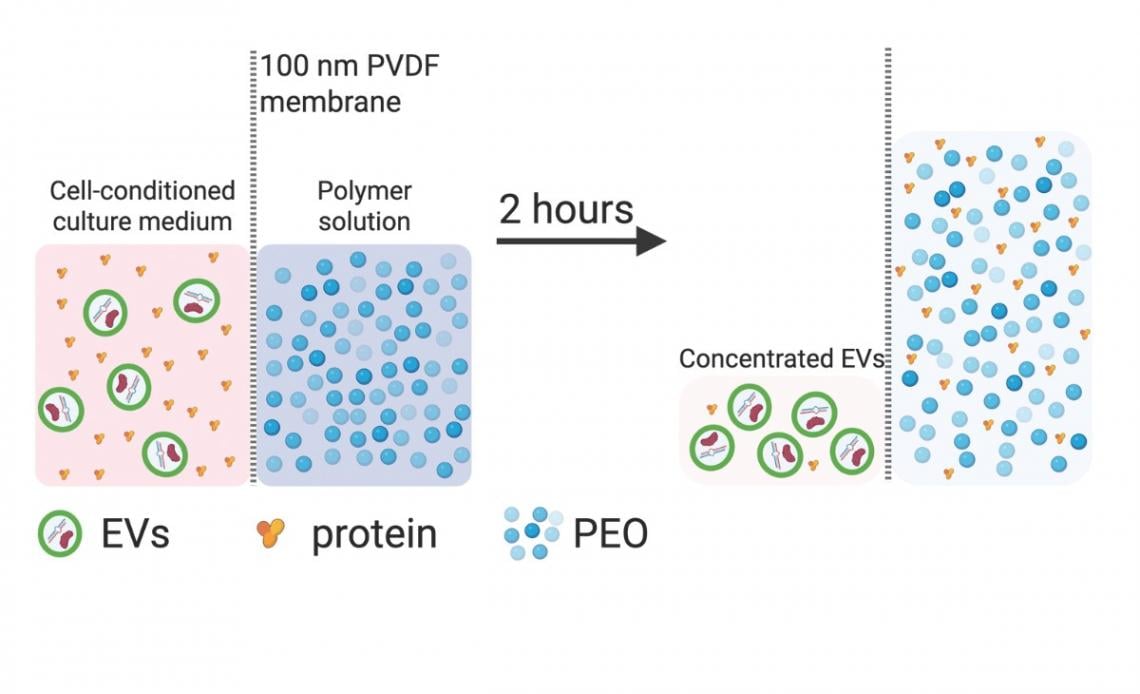
When tested in a simulated heart injury, the EVs helped protect human heart cells from oxygen deprivation, confirming their healing potential
To further improve purity, EVOs can be combined with size-exclusion chromatography. This two-step method significantly increased the concentration of EVs compared to background proteins and boosted the overall processing capacity more than tenfold.
The research team is working to expand EVOs for use with other fluids, like urine, which could be used for measuring biomarkers and diagnosing diseases. They also plan to adapt the system for large-scale biomanufacturing and future clinical testing.
“Our long-term goal is to create simple and effective tools that support both early disease detection and the development of new therapies,” explains Lai. If widely adopted, EVOs could help bring advanced EV-based technologies into more labs and clinics around the world.
Read the paper
Science and Technology of Advanced Materials: https://doi.org/10.1080/14686996.2025.2485668
Further information
Assoc Prof James Lai
[email protected]
National Taiwan University of Science and Technology
STAM Inquiries
[email protected]
STAM Editorial Office
Download this story
Advertisement