

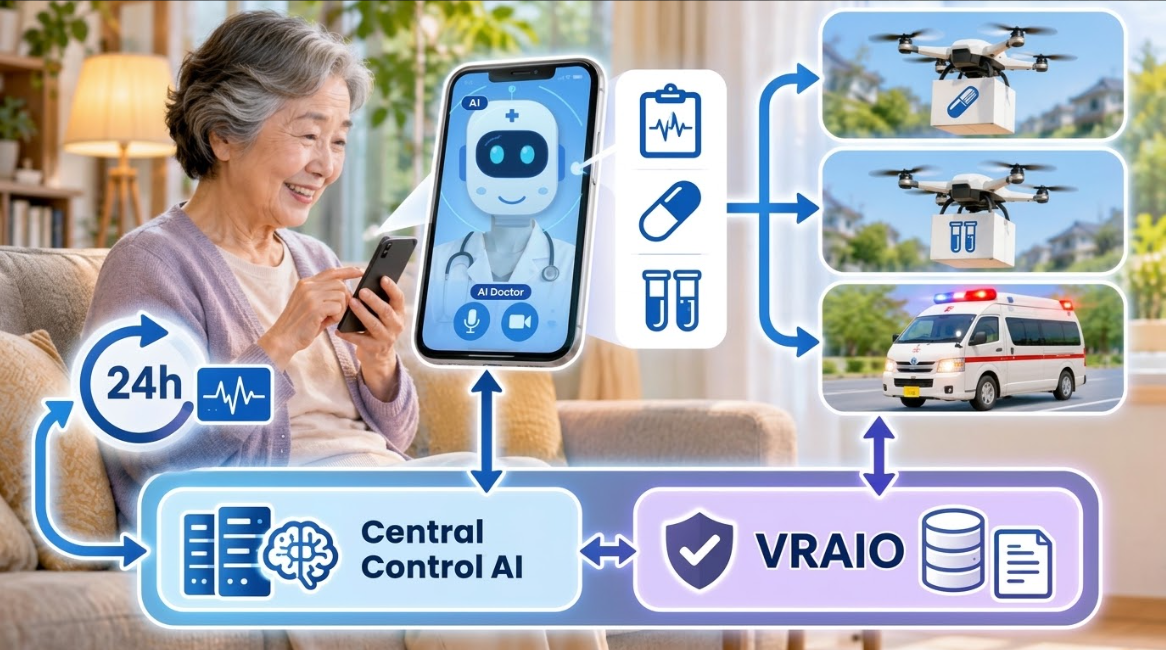

Proposing the “Clinical AI License,” a new system enabling independent initial diagnosis and prescribing.
A Perspective article by Yusaku Fujii, Professor at Gunma University, “Toward a Clinical AI License for Independent Initial Diagnosis and Prescribing in Primary Care,” has been published in the international journal AI (MDPI).
Aiming at a society in which everyone is watched over by a personal AI doctor 24 hours a day, the article proposes the “Clinical AI License,” a new licensing system that permits AI to perform initial diagnosis and prescribing independently. Rather than waiting for the arrival of AGI (artificial general
intelligence), the concept is to authorize AI step by step, starting from clinical domains in which sufficient capability and safety have been confirmed, and to widen the scope from there.
The article discusses why this system should be considered now and what social value can be expected, and sets out four requirements (performance standards, staged clinical evaluation, expansion of clinical scope, and continuous monitoring) together with the legal responsibility of the operating entity.
Key Points
• A call to license AI doctors: From AI that assists physicians to AI that independently performs initial diagnosis and prescribing within a certified scope. A proposal to move the healthcare system one step forward.
• Start without waiting for AGI: There is no need to wait for an all-capable AI doctor. Authorization begins with diseases and clinical acts that have been sufficiently evaluated.
• Four concrete licensing requirements: Domain-specific performance standards, staged evaluation modeled on clinical trials, expansion of the authorized scope, and continuous monitoring are combined.
• Clear responsibility: The license is granted to the entity that operates a certified AI under the certified conditions, and that entity bears the legal responsibility.
• Changing the shape of healthcare: The article shows a path toward continuous 24-hour consultation and support, smaller regional disparities, a response to physician shortages, and containment of healthcare costs.
The Society We Aim For: A Personal AI Doctor, 24 Hours a Day
• Care you can consult at any time: An environment in which patients can ask about symptoms and health concerns whenever they need to, including late at night and on holidays.
• Continuous understanding of each person: Medical history, medication, living conditions, and changes in health status are followed continuously, leading to advice and initial care suited to the individual.
• Diagnosis and prescribing in authorized domains: In clinical domains that AI has been evaluated as able to handle, the aim is to provide initial diagnosis, prescribing, and follow-up as one integrated service.
• Human physicians when needed: Urgent symptoms and cases outside the authorized scope are handed over promptly to human physicians and medical institutions.
Is It Time to License AI Doctors?
Recent medical LLMs have shown strong results on limited diagnostic tasks and in studies of initial management, and their application to prescribing support and medical safety is advancing. The current system, however, is structured so that clinical authority for diagnosis and prescribing is given, in principle, to qualified humans.
The issue is not to keep debating in the abstract whether AI has medical competence. It is to build a system that defines in which clinical domains, and at what demonstrated level of performance and safety, how much may be entrusted to AI.
• No need to be all-capable from the start: Introduction is considered first in domains that can be evaluated safely, such as common diseases and some stable chronic conditions.
• Built on existing medical device approval: In light of progress in SaMD (Software as a Medical Device) with autonomous functions, a system addressing the authority and responsibility for independent clinical acts is added.
The Four Requirements of the Clinical AI License
• (1) Performance standards for each clinical domain: Evaluation covers not only diagnostic accuracy but also appropriateness of prescribing, handling of contraindications, prevention of missed emergency patients, and handover to human physicians.
• (2) Staged evaluation modeled on clinical trials: Independent clinical practice is permitted after confirmation of safety and performance, multi-site comparative evaluation, and large-scale evaluation in real clinical settings.
• (3) Stepwise expansion of clinical scope: Practice begins with certified diseases and prescriptions and, based on the track record, is extended to individually approved domains.
• (4) Continuous monitoring and suspension: Performance and adverse events are monitored after introduction; if performance falls below the standard, independent practice is suspended and care is handed over to human physicians.
No Ambiguity About the Responsibility of AI Doctors
• The license is granted to the operating entity: Not the AI itself but the entity that operates the certified AI under the certified conditions becomes the license holder and bears primary responsibility for the clinical acts.
• Verifiable clinical records: Patient input, the medical knowledge referenced, the basis of the output, and the resulting decision are recorded, so that the process of diagnosis and prescribing can be verified afterward.
• Institutionalized safety and accountability: Cross-checking by multiple models, auditable records based on VRAIO, and confirmation by human physicians in the early phase of introduction are combined.
• Secured compensation for patients: Liability insurance is required of the operating entity, so that relief for patients does not depend solely on the entity’s own financial resources.
How Access to Care and Health Economics Would Change
• Narrowing regional disparities: Even in regions short of physicians, standardized initial care could become accessible remotely.
• Medical professionals where they are needed: If AI takes on routine initial care, human physicians can concentrate on complex diseases, exceptional cases, and advanced specialist judgment.
• Changing the cost of delivering care: Diagnostic capability can be extended to many regions and users, which could ease the burden on healthcare spending and health insurance finances.
• The smartphone as the entrance to care: The concept combines dialogue with the patient, images and audio, home measurement devices, and medication delivery to bring initial care into everyday life.
This Publication and Next Steps
The published article is a Perspective that presents the social significance of independent initial diagnosis and prescribing by AI and the institutional requirements for authorizing it. The tasks ahead are staged evaluation on a narrowed set of target diseases, verification of effectiveness and safety in real clinical practice, and concrete design of the legal and liability framework.
Not a binary choice of whether or not to allow AI doctors, but a question of what to entrust, under which conditions, and in what order. This work calls for discussion to advance AI medicine as a social institution.
Publication and Funding
Y. Fujii, “Toward a Clinical AI License for Independent Initial Diagnosis and Prescribing in Primary Care,” AI (MDPI), Vol.7, No.11, 480, 2026.
https://www.mdpi.com/2673-2688/7/11/480
Funding: JSPS KAKENHI 26K21972 (as stated in the Funding section of the article)
Related Key Publications
[1] Y. Fujii, “No Trust Without Trust Infrastructure: The Extended Kelvin Principle and Its Application to AI Output Governance,” AI, vol. 7, no. 6, art. no. 218, 2026. https://doi.org/10.3390/ai7060218
[2] Y. Fujii, “VRAIO as a Safety Valve: Governing AI Platform Outputs at Societal Scale,” AI and Ethics, vol. 6, art. no. 340, 2026. https://doi.org/10.1007/s43681-026-01206-z
[3] Y. Fujii, “From Measurement Failure to Privacy Infrastructure: Reframing Contact Tracing Governance for the Next Pandemic,” Journal of Medical Internet Research, vol. 28, e99645, 2026. https://doi.org/10.2196/99645
Contact
Yusaku Fujii, Professor
Graduate School of Science and Technology, Gunma University E-mail: [email protected]
Research profile: http://www.e-jikei.org/fujii/fujii.htm
For interviews, please contact the author directly by e-mail. Requests for contributed articles on this proposal are also welcome.
This press release is issued by Yusaku Fujii in his individual capacity as a researcher.
Advertisement