This story is featured in the Asia Research News 2026 magazine. Book space in the next issue now.
Get the news in your inbox
A hundred million years ago, the seas that covered modern-day Japan were teeming with life. Ammonites, bony fish, and squid coasted the waters as part of a complex late Cretaceous ecosystem.
Squid have long fascinated palaeontologists. Evolved from hard-shelled cephalopods— the class of molluscs that today include octopi, cuttlefish, and squid — these crafty invertebrates dropped their shells and became fast swimmers with impressive cognitive abilities rivalling those of vertebrates.
This single piece of evolutionary genius — losing their hard shell — is considered one of the most important evolutionary steps in the 500-million-year history of cephalopods.
But the origins and evolution of squid have long been something of a mystery, because their soft bodies tend not to fossilise. The bulk of the squid fossil record available until now has consisted of tiny, calcified lumps called statoliths that help the squid keep balance and orientation in the water.
The other way to detect squid in the fossil record is through their beaks — the hard mouthparts that do occasionally survive and become fossilised — but these are fragile and can easily be destroyed during extraction.
Rewriting the squid origin story
To solve this problem, a team of researchers from Hokkaido University, Japan, led by Yasuhiro Iba, developed a novel imaging method to digitally “mine the fossils” using grinding tomography.
Grinding tomography involves grinding the rock down layer by layer, and taking photographs of each layer to form a fully three dimensional picture of the contents of the rock.
In this study, Iba’s team developed a new, fully-automated grinding tomography system, allowing them to obtain 3D images of 1,000 cephalopod fossils in a fossil-rich late Cretaceous deposit in Japan. Of these, 263 squid beaks were described, ranging in age from 110 million to 70 million years ago, and including about 40 species completely new to science.
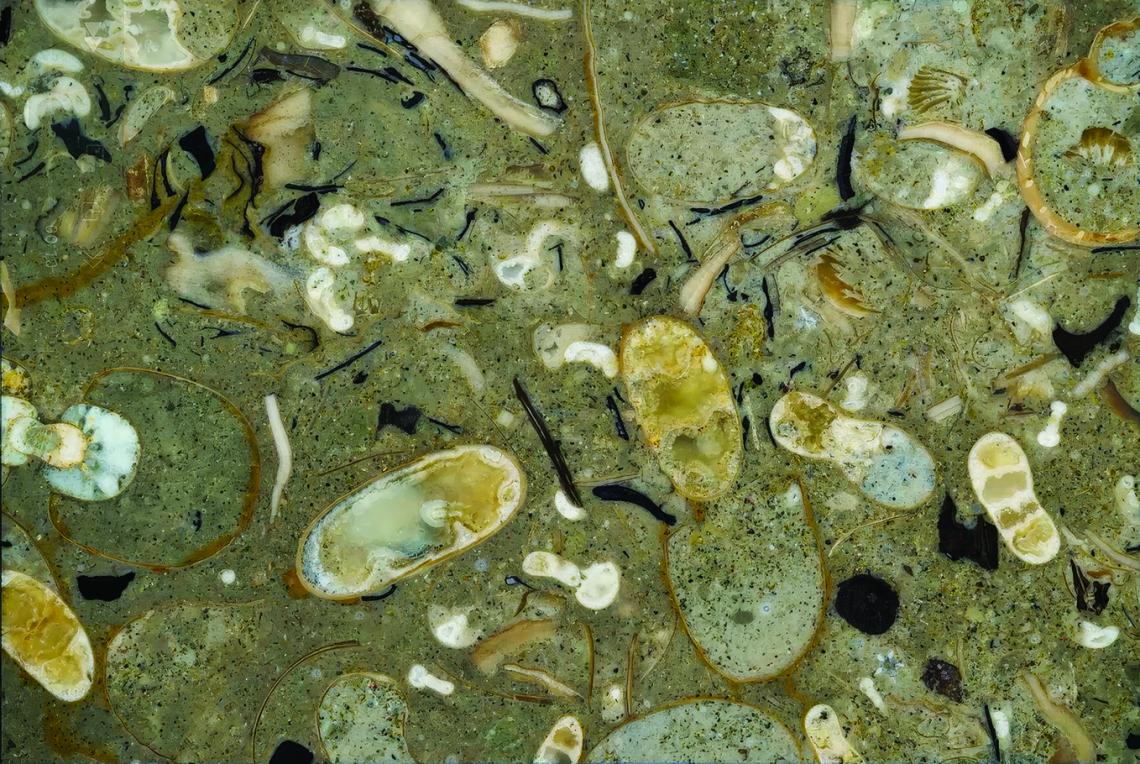
The team developed a new grinding tomography system allowing them to obtain 3D images of 1,000 fossils and discover 40 new species.
It turns out, squid evolved and became dominant much earlier than previously thought, far outnumbering both ammonites and bony fish by 100 million years ago. They were bigger, and more abundant, than both ammonites and fish, making them perhaps the dominant fast-swimmers in the ocean at that time.
“In both number and size, these ancient squids clearly prevailed in the seas,” says Shin Ikegami of the Department of Earth and Planetary Sciences at Hokkaido University, the study’s first author. “Their body sizes were as large as fish and even bigger than the ammonites we found alongside them. This shows us that squids were thriving as the most abundant swimmers in the ancient ocean.”
“These findings change everything we thought we knew about marine ecosystems in the past,” adds Iba. “Squids were probably the pioneers of fast and intelligent swimmers that dominate the modern ocean.”
Earth’s early creatures
For Iba, this discovery is just the latest breakthrough after nearly two decades of pioneering research into the evolution of Earth’s early creatures, including cephalopods, insects, corals, and single-celled organisms called foraminifera.
Iba’s passion for understanding evolution has led him and his research teams to fascinating places.
Through direct supervision and collaborations, they have found amber deposits that reveal ancient, deep-sea mega tsunamis, evidence for advanced social behaviour in 100-million-year-old ants, and uncovered the near-complete respiratory, circulatory, and excretory systems of a late Cretaceous octopod specimen.

Secrets in the stars
One of Iba’s significant contributions to science has been his work in developing high-resolution tomography systems. Tomography is an imaging technique that involves creating cross-sectional images of an object by taking multiple measurements, often using X-rays. Tomography is used in many different scientific fields, including biology, palaeontology, earth sciences, and archaeology.
One field is astrobiology, which enabled Iba to gaze up at the stars, generating high-resolution 3D models of meteorites that hint at how planets form in our solar system. Combining space and ancient earth, Iba is at the forefront of the origin of life and the Universe.
Read the paper
Science: https://www.science.org/doi/10.1126/science.adu6248
Further information
Assoc Prof Yasuhiro Iba
[email protected]
Hokkaido University
Hokkaido University Inquiries
[email protected]
Public Relations and Communications Division